Rss

  • youtube

Take heed that no man deceive you – Part I

The Apostle Paul’s second letter to Thessalonians speaks of the great falling away from the Christian faith in last days of the age just before the rapture of the church.

Now we beseech you, brethren, by the coming of our Lord Jesus Christ, and by our gathering together unto him, that ye be not soon shaken in mind, or be troubled, neither by spirit, nor by word, nor by letter as from us, as that the day of Christ is at hand. Let no man deceive you by any means: for that day shall not come, except there come a falling away first, and that man of sin be revealed, the son of perdition…[2 Thessalonians 2:1-3. KJV]

As the end of the last days nears, great numbers of the professing church will depart from biblical truth in both word and deed. This departure is called apostasy and means to “fall away” which is characterized by rebellion and abandonment of truth. Within the church, the apostasy will take two forms. The first is theological apostasy in which false leaders will depart from and reject part or all of the New Testament teachings of Christ and the apostles. Under these false leaders and teachers, a false salvation and cheap grace will replace salvation through Christ’s atoning sacrifice at Calvary, repentance, turning from sin, and adherence to God’s standards of living. The false leaders and teachers will offer a gospel centered on the self and its needs and desires. The second type is moral apostasy in which one severs his relationship with Christ and embraces sin and immorality. Although proclaiming right doctrine and New Testament Christianity’s teachings, they will abandon the moral standards as taught by the New Testament. These moral standards are exchanged for money, success, honor, and a large following.[1] Others ignore the Bible’s moral standards because they have been deceived into believing such compromise is necessary in the modern culture in order to accomplish Christ’s great commission of winning the lost.

The collective worldviews of the inhabitants of a civilization or a nation becomes the central cultural vision which informs and directs that civilization or nation with regard to ultimate questions of reality, truth, and right and wrong behavior. For fifteen hundred years the Christian worldview has been the foundation and central cultural vision of Western civilization. However, beginning about AD 1200, humanist ideologies began challenging the Christian worldview for supremacy in Western thought with regard to reality, truth, and concepts of right and wrong. America resisted the humanist onslaught far longer than Europe because of the biblical foundations for governance established by the early colonists and later Founders of the American republic. But by the latter part of the nineteenth century and early twentieth century, humanism had displaced the once dominant Christian leadership in all spheres of American life.

The erosion of Western civilization’s Christian roots had been a gradual process until the twentieth century when the forces of humanism had gained critical mass in the various spheres of culture. The once powerful and culturally dominant Christian Church was rapidly displaced and subsequently abandoned the culture—one segment by surrender (the liberals) and the other by retreat from the culture (the fundamentalists-evangelicals).

The liberal church had become fully apostate by the 1930s, and much of the leadership of many once conservative evangelical churches was well on the road to apostasy by the end of the twentieth century. Elements of the Catholic Church have been apostate for much of its history (certain popes, universities, certain congregations, and other elements of the church hierarchy). These apostate elements have recently been joined in their apostasy by Pope Francis, the current Pope of the Catholic Church. Considering what has happened over the last two hundred years in Europe and America, Kevin Swanson called this period “the most significant Christian apostasy of all time. As measured by sheer numbers, there is no other apostasy so extensive in recorded history.”[2]

Christians who know God’s word should not be surprised at this raging apostasy in the church in our time because the Bible records numerous prophesies in both the Old and New Testaments that these events would occur just before the end of the last days. In their respective ministries, both Jesus and John spent considerable time warning against apostasy and impending judgement.[3] In Matthew 24, after Jesus and His disciples left the temple, they went to the Mount of Olives where the disciples asked questions with regard to the sign of His coming and the end of the world. In verses 4 through 14, Jesus gave them general signs and events leading up to the rapture which will be followed by the seven-year tribulation period that will bring about the end of the age. The signs that Jesus gave in these verses characterize the events preceding the rapture, and these events will intensify as that time approaches. In verse 4, Jesus warned His disciples to “Take heed that no man deceive you.” One of the signs of the end of the last days is found in verse 11, “And many false prophets shall rise, and shall deceive many.” [Matthew 24:11. KJV] Because so many false prophets and religious compromisers have emerged in recent times, religious deception has become rampant throughout the planet.[4]

Apostasy may occur on a national scale where an entire nation may move away from the biblical foundations upon which their civilization was built. This has occurred in Europe and has substantially happened in America. Apostasy may also happen within segments of peoples within a nation, large denominations, local churches, and individuals. At whatever level apostasy occurs, it is the result of a shift in perspective and decrease in the commitment to a biblical understanding of reality, truth, and right and wrong. This ultimately causes large numbers of people to abandon their Christian faith entirely. Although they may retain some peripheral link with the church and Christian culture, the life sustaining connection with Christ has withered and died.[5]

The Bible has much to say about false prophets. Listed below is just a sampling of verses from both the Old and New Testaments that deal with false prophets and religious compromisers.

I have given heed and listened but they have not spoken aright; no man repents of his wickedness, saying, “What have I done?” Every one turns to his own course, like a horse plunging headlong into battle…How can you say, “We are wise, and the law of the Lord is with us”? But, behold, the false pen of the scribes has made it into a lie. The wise men shall be put to shame, they shall be dismayed and taken; lo, they have rejected the word of the Lord and what wisdom is in them. [Jeremiah 8:5-6, 8-9. RSV]

Your prophets have seen for you false and deceptive visions; they have not exposed your iniquity to restore your fortunes, but have seen for you oracles false and misleading. [Lamentations 2:14. RSV]

Let no one deceive you with empty words, for it is because of these things that the wrath of God comes upon the sons of disobedience. Therefore, do not associate with them. [Ephesians 5:6-7. RSV]

Beware of false prophets, who come to you in sheep’s clothing but inwardly are ravenous wolves…Thus you will know them by their fruits. Not every one who says to me, “Lord, Lord,” shall enter the kingdom of heaven, but he who does the will of my Father, who is in heaven. On that day many will say to me, “Lord, Lord, did we not prophesy in your name, and cast out demons in your name, and do many might works in your name?” And then will I declare to them, “I never knew you; depart from me, you evildoers.” [Matthew 7:15, 20-23. RSV]

For such men are false apostles, deceitful workmen, disguising themselves as apostles of Christ. And no wonder, for even Satan disguises himself as an angel of light. So it is not strange if his servants also disguise themselves as servants of righteousness. Their end will correspond to their deeds. [2 Corinthians 11:13-15. RSV]

For false Christs and false prophets will arise and show great signs and wonders, so as to lead astray, if possible, even the elect. [Matthew 24:24. RSV]

The Bible tells us that “My people are destroyed for lack of knowledge.” [Hosea 4:6. KJV] One of the reasons for the ease with which false prophets and religious compromisers have gained great followings in the last days is a lack of knowledge of His people. Much of the modern church is being spiritually destroyed because of the deadly combination of a lack of knowledge of God’s word and a lack of knowledge of the humanistic spirit of the age that has infiltrated the church. Without a thorough knowledge of the word of God, people cannot have a worldview that gives a rightly-ordered understanding of reality, truth, and right and wrong. Apostasy arises and spreads within His church because of deception. Lack of knowledge becomes the breeding ground for deception and apostasy.

The principal conflict of worldviews is between humanism and Christianity. Where Christians, see God as the ultimate authority in truth, reality, law, man’s salvation, man’s life and worship, humanists see man himself as the ultimate authority. That is why there is a war of worldviews in which Christianity battles against humanism’s materialism, egalitarianism, utilitarianism, abortion advocacy, evolution, socialism, and deviant sexuality.[6]

In this series we will look at specific instances of religious compromisers and false prophets that have risen to leadership within the church during these last days at the end of the age. To varying degrees they have become theologically and morally apostate. Their words, works, associations, and worldviews will be examined and compared to the unchangeable words and meaning of the Bible, and by their fruits we shall know them for what they are—apostates!

Larry G. Johnson

Sources:

[1] Donald C. Stamps, Study Notes and Articles, The Full Life Study Bible – New Testament, King James Version, gen. ed. Donald C. Stamps, (Grand Rapids, Michigan: Zondervan Bible Publishers, 1990), p. 478.
[2] Kevin Swanson, Apostate – The Men who destroyed the Christian West, (Parker, Colorado: Generations with Vision, 2013), p. 19.
[3] Ibid.
[4] Larry G. Johnson, “The Growing Apostasy in the Last Days– Part IV,” culturewarrior.net. June 3, 2016. https://www.culturewarrior.net/2016/06/03/growing-apostasy-in-the-last-days-part-iv/
[5] Swanson, p. 20.
[6] Ibid., p. 34-35.

The insidious nature of humanism

The great majority of people who understand humanism and embrace its philosophies and worldview are atheists or at best non-theistic agnostics. They must be so for the Humanist Manifestos I and II state that they “…can discover no divine purpose or providence for the human species…the human species is an emergence from natural evolutionary forces.”[1] Yet, over the last several decades millions of people who believe in the Christian God and the biblical creation have quietly and unknowingly incorporated many of the tenets of humanism into their worldviews. This number includes a large number of evangelical leaders and church members in America who have accepted these tenants because of the insidious nature of humanism. It is a sinister, treacherous, and deceptive philosophy whose followers have risen to leadership levels in all spheres of American life. That is not to say that all leaders are humanistic in their worldviews. Also, many who have incorporated elements of the humanistic philosophy are not card-carrying advocates of the humanistic philosophy but have been deceived.

Humanism is the arch-enemy of Christianity, but few Christians understand humanism or its system of beliefs. Therefore, they blindly accept many cultural ideas, initiatives, and innovations because they have been saturated by decades of indoctrination in the humanistic philosophy. Many are ignorant of humanism’s ultimate goals and ignorant of their own Christian faith that stands in opposition to those goals.

Perhaps there is no greater issue that separates the two belief systems than their respective concepts of truth. Christians believe in objective, final, unchangeable truth as found in the Bible. The humanist conceptions of truth are as follows:

The humanistic worldview regarding truth is one of cultural relativism which requires a suspension of judgment since all belief systems contain some truth within while no one belief system has all truth. For humanists, all social constructions are culturally relative as they are shaped by class, gender, and ethnicity. Thus, there can be no universal truths because all viewpoints, lifestyles, and beliefs are equally valid. As a result, no man or group can claim to be infallible with regard to truth and virtue. Rather, truth is produced by the free give and take of competing claims and opinions, that is, truth can be manufactured.[2]

But how do Christians separate truth from the lie and respond accordingly when constantly bombarded by humanistic concepts and ideas that have saturated every sphere of American life for several decades (including many churches and denominations)?

Separating the Christian and Humanistic worldviews?

First, the Christian must understand that Christ does not call His followers to win the war against Satan and his forces but to be faithful in fighting the battles he or she encounters in the everyday business of living life. To be an effective soldier in this battle, the average Christian does not have to have a degree in theology, be an articulate orator, or occupy an exalted position in society to defend one’s faith, family, and culture.

A Christian must listen and understand the beliefs, proposals, and concepts put forth by the various spheres of life in America. Although it is helpful to have knowledge of the general concepts and goals of humanism, it is more important that the Christian know what he or she believes, that is, one must know what the Bible says and why he or she believes it. It is only then that the Christian can know truth and respond appropriately. In summary, (1) listen to the beliefs, concepts, arguments, arguments, and proposals put forth, (2) restate them so you understand what is really being said, (3) rely on the Bible for guidance and direction in finding the truth, and (4) seek the Holy Spirit’s help in responding with authority and in a loving manner. As an example, let’s use this procedure in responding to a recent editorial in the Tulsa World.

In the Tulsa World Sunday edition (July 17, 2016), Associate Editor Mike Jones wrote an editorial on homosexuality titled “Love and hate.”[3] Jones states that the phrase “Love the sinner, hate the sin” is of recent origin and now used almost exclusively by those who disapprove of the lesbian, gay, bisexual, transgender community. In this editorial Jones attempts to defend homosexuality by challenging the Christian’s interpretation of the meaning of the Bible as well as challenging the truth of the Bible itself with regard to homosexuality.

The complete truthfulness of the Bible is challenged

“Love the sinner, hate the sin” never appears in the New Testament. There are verses that can be applied or construed to prove that God or Jesus disapproved of homosexuality. Ignoring Leviticus, Romans 1:26-27 can be read to address men cavorting with men and women with women. But also, that chapter along with at least seven others, and arguably more, in the New Testament were written by Paul, and we can argue all day about whether Jesus told him what to write.[4] [emphasis added]

What is Jones really saying? He is saying that: (1) All scripture is not the inspired word of God. (2) Those portions of the scripture condemning homosexuality aren’t applicable because Jesus did not explicitly condemn homosexuality.

There is no question that the Apostle Paul condemned homosexuality in a very forthright and plain manner (Romans 1: 18, 24-27), and Jones does not dispute that Paul held this view of homosexuality. What Jones is challenging is the truthfulness or validity of portions of the Bible when he says that we can argue all day about whether Jesus told Paul what to write. By using Jones’ line of reasoning, we must ignore the divine inspiration of much if not all of scripture. Consequently, the Bible is not objective truth, contains errors, and is effectively reduced to a book of suggestions of mortal men except perhaps for the red letters depicting Christ’s words in the New Testament. However, Jones ignores the fact that the Bible itself speaks of its supreme authority in all matters of truth. Also, most Christians believe that Paul’s admonishment that homosexuality is a sin is part of the inspired word of God and is no less inspired than the writings of those who recorded the words of Christ in the gospels.

Homosexuality is not a sin

… many more passages can be found in the New Testament where Jesus was reported to have urged his followers to love everyone. Opting for the “sin” phrase is basically telling a gay man that he is a sinner. Of course, that also implies that their sexual preference is a chosen lifestyle. So, simply put, you are condemning to hell that person you say you really want to love.[5] [emphasis added]

What is Jones really saying? (1) He makes no distinction between the person and their sin. (2) We must love the homosexual and ignore their lifestyle.

Jones argues that there are many more passages in the New Testament where Jesus urges his followers to love everyone. He says that opting for the sin portion of “love the sinner, hate the sin” phrase is “basically telling a gay man that he is a sinner.” But that is exactly what Paul is saying. Homosexuality is a sin along with other sins such as evil thoughts, fornication, theft, murder, adultery, coveting, wickedness, deceit, licentiousness, envy, slander, pride, and foolishness.

Homosexuality is not destructive to marriages, families, and to society in general

I will never understand why people are so afraid. I’ve heard their reasons: “Homosexuality destroys families!” “Homosexuality destroys marriage!” “We have to save these sinners from AIDS!” “It’s an abomination unto God!”

No one has ever explained to me how families or marriages are destroyed. There are far too many happy, solid families comprised of gay couples. And I think the straight community is doing a good enough job on its own in the destroying marriage and families department.

The claim of saving them from AIDS is another smokescreen. Gay men know how to save themselves from AIDS. We’ve learned a lot about that disease — one being it’s not a curse from God.[6]

What is Jones really saying: There is no evidence of the damage done by homosexuality to families, marriages, and the larger society.

However, there is abundant evidence throughout history that homosexuality does destroy marriages, families, and nations. Many current studies and statistics support this contention. Even without scientific studies and a truthful examination of history, we can know that homosexuality is undeniably damaging to individuals, families, and society in general. How do we know this? God deems homosexuality as a sin, and “The wages of sin is death…” (Romans 6:23). Biblical truth is non-negotiable, and no amount of conversation, argument, debate, and reasoning among men, however sincere and well-meaning, will change this.

Homosexuals were born that way and therefore cannot be morally condemned

Telling a gay couple that they are committing a sin is like telling a blue-eyed kid that he needs to change the color of his eyes because God hates blue-eyed people and having blue eyes is a sin. Of course you wouldn’t say such an outrageous and hurtful thing to a child or anyone. After all, they were born with blue eyes. Either genetics put them there or God did. That can’t be changed.[7]

What is Jones really saying? Homosexuality cannot be morally condemned because homosexuals were born that way.

Defenders of homosexuality argue that moral distinctions between homosexuality and heterosexuality are invalid because homosexuals were born that way. Christians can point out that sound scientific studies have not proven that homosexuality has a genetic basis (either causal or predispositional). Recent support for the Christian position came from one of the most unlikely sources. The New Atlantis is a journal of technology and society dedicated to the LGBT community. It published a newly released report co-authored by two psychiatric experts affiliated with Johns Hopkins University School of Medicine. The report is titled “Sexuality and Gender: Findings from the Biological, Psychological and Social Sciences,” and states that “Born that way” is a myth.

The understanding of sexual orientation as an innate, biological fixed property of human beings—the idea that people are “born that “—is not supported by scientific evidence… Genes constitute only one of the many key influences on behavior in addition to environmental influences, personal choices, and interpersonal experiences.[8] [emphasis added]

However, the Christian must never accept or surrender his biblical beliefs about homosexuality based on the findings of scientists. But for the sake of argument, let’s assume that homosexuality was not a choice but a genetic predisposition or even genetically caused. The Christian can show that humans are born with many scientifically determined predispositions or genetic factors that result in culturally unacceptable behavior such as alcoholism. One study established a genetic link to criminal behavior. But such scientific evidence of genetic links does not justify immoral behavior whether it is alcoholism, criminal activity, or homosexual practices.

Condemning homosexuality as a sin is the same as hating the homosexual

Finding someone you love and wanting to spend the rest of your life (or at least a good portion of it) with them is certainly not sinful. They aren’t wrecking families, killing the institution of marriage and they are not ruining kids’ lives.

Adopting and defending the word “hate” certainly does not follow the teachings of Jesus.

You want to put someone’s life on your version of the straight and narrow, go find someone in your congregation and tell them to quit drinking so much or that dancing might place them on the road to degradation.

I think I know what the answer will be: Mind you own business.

Good advice.[9] [emphasis added]

What is Jones really saying? He is saying that hating the sin of homosexuality does not follow the teachings of Jesus. However, humanists who claim love is all that is necessary to merit the grace of God either ignore or dismiss the centrality of the cross in the great meta-narrative of the Bible with regard to creation, the fall, and man’s need for redemption. Christ died for the sins of the world to make possible God’s forgiveness of sinful man, and every man has a choice as to whether or not he will accept that forgiveness and follow Christ. To follow Christ is to follow the Bible’s commandments. But, if love is all that is necessary, then Christ’s death on the cross becomes irrelevant because God’s holiness must then coexist with sin. Therefore, how men live their lives has no bearing on their eternal destination.

Jones is also saying that Christians should continue to do good works, that condemnation of homosexuality as a sin is the same as hating the homosexual as a person, that the Bible is wrong where is says that homosexuality is a sin, and that Christians should ignore homosexuality and focus on “real” sins. In essence, Jones is saying to the Christian, “Shut up and mind your own business!” Thus, Christianity and Christian beliefs are banned from influence in the public square. That is the recurrent message of humanism.

How is the Christian to respond? This writer has often quoted the Dietrich Bonhoeffer’s words to his fellow pastors who were being arrested and sent to Nazi concentration camps in the late 1930s. As they faced persecution, imprisonment, and even death, he cautioned them to retain the biblical understanding of sin, repentance, and forgiveness.

Anyone who turns from his sinful way at the word of proclamation and repents, receives forgiveness. Anyone who perseveres in his sin receives judgment. The church cannot loose the penitent from sin without arresting and binding the impenitent in sin…Grace cannot be proclaimed to anyone who does not recognize or distinguish or desire it…The preaching of grace can only be protected by the preaching of repentance.”[10]

______

There are millions of people in America like Mike Jones who champion the humanist worldview, twist the words and meaning of the Bible, and in the end challenge the truth of the Bible in order to advance the humanist agenda. Many of them are unaware of what they are doing or the consequences thereof. Yet, Christians must be alert, faithful, and persistent in presenting the truth of God’s word and defending their Christian faith. Because America is no longer a Christian-friendly nation, Christians must expect that their opposition to the humanist philosophy and agenda will subject them and their families to marginalization, ridicule, harassment, loss of educational and job opportunities, financial loss, imprisonment, and possibly even more severe forms of persecution. However, the Christian’s consolation is found in the New Testament book of James.

Count it all joy, my brethren, when you meet various trials, for you know that the testing of your faith produces steadfastness. And let steadfastness have its full effect, that you may be perfect and complete, lacking nothing. [James 1:2-4. RSV]

Larry G. Johnson

Sources:

[1] Paul Kurtz, ed., Humanist Manifestos I and II, (Amherst, New York: Prometheus Books, 1973), pp. 16-17.
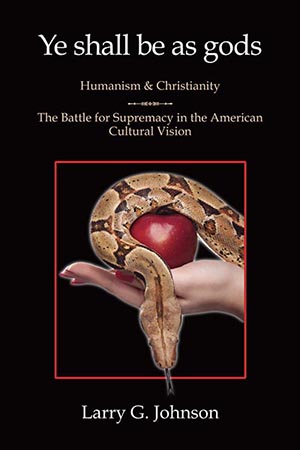
[2] Larry G. Johnson, Ye shall be as gods – Humanism and Christianity – The Battle for Supremacy in the American Cultural Vision, (Owasso, Oklahoma: Anvil House Publishers, 2011), pp. 392-393.
[3] Mike Jones, “Love and hate,” Tulsa World, July 17, 2016, G1.
[4] Ibid.
[5] Ibid.
[6] Ibid.
[7] Ibid.
[8] Mary Rice Hasson and Theresa Farnon, “Report Debunks ‘Born That Way’ Narrative And ‘Transgender’ Label For Kids,” The Federalist, August 23, 2016.
http://thefederalist.com/2016/08/23/report-debunks-born-that-way-narrative-and-transgender-label-for-kids/ (accessed September 1, 2016).
[9] Jones, “Love and hate,” G-1.
[10] Eric Metaxas, Bonhoeffer, (Nashville, Tennessee: Thomas Nelson, 2010), pp. 292-293.

Pacifist Christians in the Culture Wars – Part II

Two paradigms for cultural engagement: persuasion v. warfare

In his book Thriving in Babylon Larry Osborne describes two opposing paradigms of cultural engagement: persuasion and warfare. He has chosen Daniel of the Old Testament as the role-model for the persuasive, non-combative approach of Christians to a hostile culture. He describes those in the warfare paradigm as focusing on fighting the spread of sin on all fronts and who envision themselves as “frontline soldiers in a great spiritual battle between the forces of evil and those who uphold biblical values.”[1] Osborne believes that modern evangelicals who see the culture in terms of spiritual warfare have gotten it all wrong and should emulate Daniel.

When the biblical authors speak of spiritual warfare, it’s always framed in the context of our personal spirituality. The warfare model focuses on the wrong enemy. Non-Christians are not the enemy. They’re the victims of the Enemy. Victims need to be rescued, not wiped out.”[2] [emphasis added]

Here we find the great error of Osborne and like-minded culturally pacifist Christians in engaging the culture. Spiritual warfare is not always framed in the context of personal spirituality. The Bible has a great deal to say about spiritual warfare, and Donald Stamps in “The Christian’s Relationship to the World” describes the cultural battlefield where this war is fought.

The term “world’ often refers to the vast system of this age which Satan promotes and exists independent of God…In this age Satan uses the world’s ideas, morality, philosophies, psychology, desires, governments, culture, education, science, art, medicine, music, economic systems, entertainment, mass media, religions, sports, agriculture, etc., to oppose God, His people, His word and His righteous standards… Believers must be aware that behind all human enterprises there is a spirit, force, or power that moves against God and His Word, some to a lesser degree, some to a greater degree. Finally, the “world” also includes all man-made religious systems and all unbiblical, worldly, or lukewarm “Christian” organizations and churches…In the world believers are strangers and pilgrims.[3]

The individual Christian and the Church (body of Christ) must stand in opposition to the world system. When the biblical authors speak of spiritual warfare, they refer not only to personal spiritual preparation but also to being prepared to wage spiritual warfare in the larger culture as described by Paul’s letter to the Ephesians.

Finally, be strong in the Lord and in the strength of his might. Put on the whole armor of God, that you may be able to stand against the schemes of the devil. For we do not wrestle against flesh and blood, but against the rulers, against the authorities, against the cosmic powers over this present darkness, against the spiritual forces of evil in the heavenly places. Therefore take up the whole armor of God, that you may be able to withstand in the evil day, and having done all, to stand firm. [Ephesians 6:10-14. KJV]

If not in the culture, where are Christian supposed to war against rulers, authorities, cosmic powers over the present darkness, against spiritual forces of evil in heavenly places? Christians are Christ’s voice and legs in the spiritual battle against a “world” system ruled by Satan. Christians must not see spiritual warfare only in the “context of our personal spirituality” as claimed by Osborne. It is in the culture that we must stand firm in the evil day. The Apostle Paul had much to say about spiritual warfare in the culture, and the following are just three of his admonitions.

For though we live in the world we are not carrying on a worldly war, for the weapons of our warfare are not worldly but have divine power to destroy strongholds. We destroy arguments and every proud obstacle to the knowledge of God, and take every thought captive to obey Christ. [2 Corinthians 10:3-5. RSV] [emphasis added]

Preach the word; be urgent in season and out of season; convince, rebuke and exhort, be unfailing in patience and teaching. [2 Timothy 4:2. RSV] [emphasis added]

Let no one deceive you with empty words, for it is because of these things that the wrath of God comes upon the sons of disobedience. Therefore do not associate with them…Take no part in the unfruitful works of darkness, but instead expose them. For it is a shame to even speak of the things that they do in secret; but when anything is exposed by the light it becomes visible. [Ephesians 5: 6-7,11-13. RSV] [emphasis added]

The face of spiritual warfare in German culture of the 1930s

Martin Niemöller was a captain of a German U-boat during World War I and was awarded the Iron Cross for Bravery. Although a distinguished pastor in the German Lutheran Church, Niemöller supported the Nazis’ early efforts at restoring Germany’s dignity, ridding the country of communists, and restoring moral order. In a private meeting with Hitler in 1932, Hitler promised Niemöller that he would not interfere with the German churches and would not institute pogroms (persecutions and exterminations) against the Jews.[4]

But as the Nazi regime consolidated its power in early 1933, Niemöller saw the underlying agenda of Hitler. A small minority of pastors, churches, and individual Christians in Germany began opposing Hitler and the apostate German church that had capitulated to his ideas and agenda. The resistance centered within the new “Confessing Church” led by Niemöller, Dietrich Bonhoeffer, and a few others. When Hitler heard of a potential church split because of objections to his policies, he summoned several dissenting church leaders including Niemöller to the Reich Chancellery. He lectured the assembled churchmen and said all he wanted was peace between Church and state and blamed them for obstructing his plans. Hitler warned them “…to confine yourself to the Church. I’ll take care of the German people.” Niemöller responded that the Church also had a responsibility toward the German people that was entrusted to them by God and that neither Hitler nor anyone else in the world had power to remove that responsibility. Hitler turned away without comment, but that same evening the Gestapo ransacked Niemöller’s rectory while searching for incriminating material. Within days a homemade bomb exploded in the hall of the rectory.[5]

As Nazi pressure was ratcheted up against the dissenting churchmen, Niemöller and Bonhoeffer were criticized by their fellow churchmen for opposing Hitler and his policies. Eventually over two thousand would choose the route of appeasement and safety and abandoned support of Bonhoeffer and Niemöller’s efforts in resisting the Nazis. “They believed that appeasement was the best strategy; they thought that if they remained silent they could live with Hitler’s intrusion into church affairs and his political policies.”[6] In the late summer of 1933, Niemöller wrote a letter to a friend about his opposition to Hitler.

Although I am working with all my might for the church opposition, it is perfectly clear to me that this opposition is only a very temporary transition to an opposition of a very different kind, and that very few of those engaged in this preliminary skirmish will be part of the next struggle. And I believe that the whole of Christendom should pray with us that it will be a “resistance unto death,” and that the people will be found to suffer it.[7]

In early 1934 from the pulpit of his church in the Berlin suburb of Dahlem, Niemöller spoke of the coming trials that faced the German church.

We have all of us—the whole Church and the whole community—we’ve been thrown into the Tempter’s sieve, and he is shaking and the wind is blowing, and it must now become manifest whether we are wheat or chaff! Verily, a time of sifting has come upon us, and even the most indolent and peaceful person among us must see that the calm of a meditative Christianity is at an end…

It is now springtime for the hopeful and expectant Christian Church—it is testing time, and God is giving Satan a free hand, so he may shake us up and so that it may be seen what manner of men we are!…

Satan swings his sieve and Christianity is thrown hither and thither; and he who is not ready to suffer, he who called himself a Christian only because he thereby hoped to gain something good for his race and his nations is blown away like chaff by the wind of time.[8]

In 1937, Niemöller and more than eight hundred other churchmen were arrested and imprisoned for their opposition to the Nazis. Following release from prison after eight months, Niemöller was immediately arrested again as a “personal prisoner” of the Führer himself and spent the next seven years in Dachau, one the Nazis’ most infamous concentration camps. He was freed by the Allies in 1945.[9]

After the war, in his sorrow for not recognizing and speaking out in the early days of the Nazi rise to power, Niemöller penned this sorrowful message.

First they came for the Socialists, and I did not speak out—Because I was not a Socialist.

Then they came for the Trade Unionists, and I did not speak out—Because I was not a Trade Unionist.

Then they came for the Jews, and I did not speak out—Because I was not a Jew.

Then they came for me—and there was no one left to speak for me.[10]

The face of spiritual warfare in American culture of the twenty-first century

The present course of American culture is much like that of Germany in the early 1930s. Although America’s Godly heritage and the protection of religious freedom built into the Constitution have been powerful deterrents to the agendas of humanism and pagan religions, those deterrents have been substantially weakened over the course of the last three generations as humanistic and pagan philosophies gained ascendance and critical mass in American society. But culturally pacifist Christians like Osborne tell us not to worry. We can thrive in Babylon if we will only have the right perspective and make friends with and serve the powers that be. However, that will require Christians to embrace new definitions of tolerance and perhaps compromise on some of the less important details of their faith.

But it is not a time for “chilling out” or attempting to “thrive” in an increasingly hostile culture. In his commentary on Ephesians 6:11, Donald Stamps paints a much different picture of the Christian’s calling and obligations of spiritual warfare in the culture.

In their warfare of faith, Christians are called upon to endure hardships as good soldiers of Christ, suffer for the gospel, fight the good fight of faith, wage war, be victorious, defend the gospel, strive for the faith, not be alarmed by opponents, put on the full armor of God, stand firm, destroy Satan’s strongholds, take captive every thought, become mighty in war, and contend for the faith.[11]

As it was in Germany of the early 1930s, the America church has been thrown into the Tempter’s sieve, and he is shaking and the wind is blowing, and it must now be revealed whether the church is wheat or chaff. As Niemöller admonished the German church to pray in the late summer of 1933, the American church should now pray that their resistance will also be a “resistance unto death,” and that the people will be found to suffer it.

Larry G. Johnson

Sources:

[1] Larry Osborne, Thriving in Babylon – Why Hope, Humility, and Wisdom matter in a godless culture,” (Colorado Springs, Colorado: David C. Cook, 2015), p. 161.
[2] Ibid., pp.162-163.
[3] “The Christian’s Relationship to the World,” The Full Life Study Bible – King James Version – New Testament, Gen. Ed. Donald C. Stamps, (Grand Rapids, Michigan: Zondervan Bible Publishers, 1990, pp. 578-579.
[4] Eric Metaxas, Bonhoeffer, (Nashville, Tennessee: Thomas Nelson, 2010), p. 177.
[5] Erwin W. Lutzer, When a Nation Forgets God, (Chicago, Illinois: Moody Publishers, 2010), pp. 19-20.
[6] Ibid., p. 21.
[7] Metaxas, Bonhoeffer, p. 197.
[8] Lutzer, When a Nation Forgets God, p. 32-32.
[9] Metaxas, Bonhoeffer, pp. 293, 295.
[10] Ibid., p. 192.
[11]Stamps, Commentary on Ephesians 6:11, The Full Life Study Bible – King James Version – New Testament, p. 439.

Pacifist Christians in the Culture Wars – Part I

“If you haven’t noticed, the culture wars are over. We lost.”[1] This was written by Larry Osborne, senior pastor of North Coast Church, a multi-campus megachurch of 11,000 members headquartered in Vista, a city in San Diego County, California. Osborne is one of a growing group of highly influential evangelical leaders and their followers who have abandoned the culture wars. Not only have these evangelical leaders and many of their followers abandoned the culture wars, many are trying to justify their actions by claiming overt resistance to an ungodly culture is non-biblical. Osborne’s book presents several ideas and arguments which ultimately become a pacifistic approach to cultural engagement by Christians. In Part I we shall examine four of these ideas and philosophies.

Some things aren’t worth dying for

Osborne titled Chapter 17 of Thriving in Babylon “Wisdom – Some Things Aren’t Worth Dying For.” In this chapter he states that lack of perspective is a sign of Christian immaturity.

Waiting is not an option. Compromise is a dirty word. Everything is equally important. There are no nuances. Everything is black and white. And immediate consequences are the only consequences that matter.[2]

Basically, Osborne is saying that immature Christians should “chill out” when it comes to many things in culture. Mature Christians must have perspective. To a limited degree Osborne is correct. Christians must pick their cultural battles wisely. They must know the difference between sin and things that are just personally offensive, and they must always keep the big picture in mind. This is good advice for the Christian culture warrior.

Osborne points to Daniel as a biblical example of someone with perspective. Unfortunately, Osborne doesn’t stop there. He called Daniel “a man of great forbearance” which he immediately defines at biblical tolerance. Using Osborne’s chain of reasoning, Christian maturity arises from having perspective which becomes tolerance in the “biblical sense of the word.” Osborne states that tolerance, rightly understood, is “allowing people the right to be wrong.” He also states that tolerance has wrongly come to mean that nobody is wrong.

Those who dare to claim that some behaviors are actually morally wrong are written off as intolerant bigots. And ironically, they become the one group nobody is tolerant of. While many bemoan the intolerance directed toward Bible-believing Christians, we have no one to blame but ourselves. Back when Christianity was the dominant cultural religion, we often used our power to shut down those who advocated opposing agendas.[3]

Humanism’s definition of tolerance begins with the denial of absolutes because no man or group can claim ownership of truth which is often the product of the free give and take of conflicting opinions. The humanist stance towards toleration results in moral relativism which is the antithesis of Christian belief. But the practical outworking in culture of Osborne’s understanding of tolerance effectively silences the presentation of biblical truth by those holding the Christian worldview. The truth claims of pagan religions are left unanswered, and humanism is left unchallenged as the humanistic cultural tsunami spreads across the nation.

Osborne’s stance on tolerance leads to an equally faulty understanding of compromise which he believes isn’t necessarily a dirty word. As with tolerance, Osborne makes some good points with regard to compromise. Yet, he attempts to link compromise with things that have nothing to do with compromise. He states that the wise “know what battles they can win and what battles need to be fought later.”[4] Neither of these statements are indications of compromise. Knowing whether one can win a battle or not is not the deciding factor as to whether that battle ought to be fought. Delaying a battle is not compromise either. These decisions should be determined by prayer and the leading of the Holy Spirit.

Christians must remember that God is holy and will not tolerate sin. What passes for tolerance and compromise in many of today’s churches is nothing more than accommodation to the spirit of the world by churches and their leadership. A. W. Tozer described this tendency in Christianity more than sixty years ago.

Christianity is so entangled with the spirit of the world that millions never guess how radically they have missed the New Testament pattern. Compromise is everywhere. The world is whitewashed just enough to pass inspection by blind men posing as believers, and those same believers are everlastingly seeking to gain acceptance with the world. By mutual concessions men who call themselves Christians manage to get on with men who have for the things of God nothing but contempt.[5] [emphasis added]

Christian resistance to worldly leaders – Attempting to impose their will on non-Christians

Osborne likens the evangelical efforts to resist worldly leaders and their humanistic and pagan cultural influences flooding America as imposing Christianity on non-Christians. “We’re no longer trying to impose our will on non-Christians. We’re trying to keep non-Christians from imposing their will on us—and our churches.”[6]

Daniel also had the wisdom to understand that godless people live godless lives. He never forced his righteous lifestyle on others even as he rose to positions of power, he didn’t try to impose his walk with God on those who didn’t know God.[7]

Back when Christianity was the dominant cultural religion, we often used our power to shut down those who advocated opposing agendas…We’d boycott non-Christian companies for making non-Christian decisions…I often wonder what would have happened if we’d had the wisdom of Daniel when we were in control…Whether Daniel was at the bottom of the food chain or near the top, he never tried to force his righteousness on others…and thus earned the right to be heard.[8]

It is apparent that Osborne is substantially ignorant of American history, the nation’s founding, and the role of Christianity in its culture until the mid-twentieth century. The Founders weren’t forcing anyone to accept a righteous lifestyle. The Constitution and laws of the land established boundaries and became a foundation for the nation’s central cultural vision.

From this misunderstanding of religion’s duties and rightful place in public square, Osborne and many other highly influential but pacifistic Christian leaders have generally withdrawn from any significant involvement in politics and government over the last three decades. To challenge this belief, Wayne Gruden published a pamphlet titled, “Why Christians should seek to influence the government for good.” Gruden presents a strong biblical basis for Christian involvement to “significantly influence law, politics, and government …according to God’s moral standards and God’s purposes for government as revealed in the Bible.” At the same time Gruden cautions that Christians “…must simultaneously insist on maintaining freedom of religion for all citizens.”[9] How is this balance achieved?

…the overarching moral suasion (influence or persuasion) of Christian principles under which our nation was founded made possible religious freedom for all faiths. Such moral suasion of Christian principles is not coercive as humanists would have us believe. The moral suasion of Christian principles provided the nation with a central vision and resulted in stability and unity by working through the individual as he voluntarily chooses the manner in which he orders his soul.[10]

Engage the culture by winning friends and influencing people

Osborne attempts to repackage Daniel’s humble nature as “service” to his wicked captors and masters. Therefore, “service” becomes the essential ingredient in constructing the “persuasive” paradigm for engaging culture.

He served his captors and wicked masters so well and loyally that he kept getting promoted. And with every promotion, his influence in Babylon grew greater…Yet I’m afraid that a modern-day Daniel would be harshly criticized. Many Christians would see him as a spiritual compromiser…Instead of avoiding or attacking the godless leaders of our day, we’ll need to begin to engage them in the same way Daniel did, humbly serving whomever God chooses to temporarily place into positions of authority.[11]

Osborne erroneously attempts to define biblical humility as “…simply serving others by putting their needs and interest above our own. It’s treating others the same way we’d treat them if they were someone ‘important’.” But Osborne’s definition of humility is not to be found in the dictionary.

Noah Webster Dictionary of 1828: Humility: In ethics, freedom from pride and arrogance, humbleness of mind, a modest estimate of one’s own worth. In theology, a lowliness of mind, a deep sense of one’s own unworthiness in the sight of God. Self-abasement, penitence for sin, submission to the Divine will.[12]

Merriam-Webster Dictionary of 1963: Humility: Quality or state of being humble. Humble: Not proud or haughty. Spirit of deference, not arrogant or assertive, submission, ranking low in some hierarchy of scale.[13]

Osborne’s definition of biblical humility is manifestly false, but it appears to be the core of much of pacifist Christians’ reasons for avoiding the culture wars. It is the seeker-sensitive model of Church Growth designed to reach the lost but modified for the culture at large. However, the Bible commands Christians to speak truth (with love and true humility) into culture as opposed to attempting to influence it through a fawning ingratiation and toady servitude to gain favor with ungodly leaders in a wicked culture. Christians are supposed to be salt and light to a lost and dying world. Although we are required to show Christian love, charity, and bind up the wounds of the broken, such must not be a weak substitute for truth. Writing over sixty years ago, A. W. Tozer anticipated the end-product of modern but misguided pacifist Christian efforts at an ill-defined and misplaced humility.

The Christian faith, based upon the New Testament, teaches the complete antithesis between the Church and the world…It is no more than a religious platitude to say that the trouble with us today is that we have tried to bridge the gulf between two opposites, the world and the Church, and have performed an illicit marriage for which there is no biblical authority. Actually, there is no real union…When the Church joins up with the world it is the true Church no longer but only a pitiful hybrid thing, an object of smiling contempt to the world and an abomination to the Lord.[14]

The American church of the 1950s was not a “spiritual Camelot”

Osborne believes that much of the perceived cultural deterioration that supposedly motivates today’s Christian culture warriors is a result of their looking at the past through rose-colored glasses.

Consider how many Christians look back at the 1950s and the days of Leave It to Beaver as the golden era of family values and godly culture…While they were indeed good times if you were a white middle-class suburbanite, they were hardly the glory days of family values and godly culture if you were a black family living under the last vestiges of segregation and Jim Crow.[15]

For instance, the glory days of Father Knows Best, family values, and stay-at-home moms weren’t all they were cracked up to be…once again, as in Roman days, a powerful church is not always a faithful church. It draws people for the wrong reason.

Frankly, if those days were really a spiritual Camelot, someone needs to explain to me how they produced a generation of sex-crazed, free-love, dope-smoking hippies who grew up to be self-absorbed boomers.[16]

Much like the humanistic progressives of today, Osborne disparages the American church of the 1950s which he claims were not “the glory days of family values and godly culture.” Rather, he describes it as a powerful church but not a faithful church.

Here we have two classic examples of assumptive language in which it is taken for granted that the results are caused by what precedes the results. In the first example of assumptive language, Osborne claims that the glory days of family values and godly culture couldn’t have existed because there were other segments of society that were suffering. In the second example of Osborne’s assumptive language, the church was culturally powerful; therefore we must assume that it couldn’t have been spiritual. As evidence of the lack of spirituality of the 1950s church, Osborne’s assumptive language points to the rebellious Boomer generation as being caused by the 1950s church. But Osborne lost (or perhaps never had) his much coveted historical perspective as to the reasons for the rise of the Boomer generation.

The history of the 1950s church in America and the cause of the Boomer rebellion have been written about extensively. Those well-documented and authoritative histories emphatically do not support Osborne’s conclusions reflected by his assumptive statements.
______

In Part I we have examined four ideas and philosophies that foster Christian pacifism in the culture wars as championed by Osborne and others. In Part II, we shall glean the essences of the two opposing views of Christian cultural engagement and examine those in comparison to the role of the church in the German culture of the 1930s.

Larry G. Johnson

Sources:

[1] Larry Osborne, Thriving in Babylon – Why Hope, Humility, and Wisdom matter in a godless culture,” (Colorado Springs, Colorado: David C. Cook, 2015), p. 136.
[2] Ibid., p. 169.
[3] Ibid., pp. 174-175.
[4] Ibid., p. 185.
[5] A. W. Tozer, God’s Pursuit of Man, (Camp Hill, Pennsylvania: WingSpread Publishers), p. 115.
[6] Osborne, Thriving in Babylon, p. 136.
[7] Ibid., p. 173.
[8] Ibid., pp. 175-176.
[9] Wayne Gruden, “Why Christians should seek to influence the government for good.” Booklet adapted from Wayne Gruden, Politics – According to the Bible – A Comprehensive Resource for Understanding Modern Political Issues in Light of Scripture, (Grand Rapids, Michigan: Zondervan, 2010).
[10] Larry G. Johnson, Ye shall be as gods – Humanism and Christianity – The Battle for Supremacy in the American Cultural Vision, (Owasso, Oklahoma: Anvil House Publishers, 2011), p. 224.
[11] Osborne, Thriving in Babylon, pp. 150-151.
[12] “humility,” Noah Webster, American Dictionary of the English Language 1828, Facsimile Edition, (San Francisco, California: Foundation for American Christian Education, 1967, 1995 by Rosalie J. Slater), p. 12.
[13] “humble, humility,” Webster’s Seventh New Collegiate Dictionary, (Springfield, Massachusetts: G. & C. Merriam Company, Publishers, 1963), pp. 404-405.
[14] A. W. Tozer, God’s Pursuit of Man, pp. 115-116.
[15] Osborne, Thriving in Babylon, p. 36.
[16] Ibid., pp. 195-196.

How much is your child worth?

You’ve probably heard or read about Harambe of the Cincinnati Zoo. He was the 420 pound silverback gorilla that was shot and killed on May 28th by zoo officials to protect the life of a 3-year old child that managed to slip into Harambe’s domain. Such is the outrage at the killing by many in our humanistic society that the story has spun across several 24-hour news cycles as well as exploded in the internet and print media.

The preschooler managed to wiggle into zoo’s Gorilla World enclosure, walk through some bushes, and then fell down the 15 wall into a moat that separated the gorilla from onlookers. The gorilla went to the child and was reported to have been “violently dragging and throwing the child.” Within ten minutes zoo officials had been notified and responded. Zoo officials determined that it was too dangerous to attempt to use a tranquillizer gun because it might enrage the gorilla during the time it takes for the tranquilizing drug to take effect. Instead they made the decision to shoot and kill the gorilla.[1] Jack Hanna, the respected and renowned American zookeeper, fully agreed with the decision. Hanna said he saw video of the gorilla jerking the boy through the water and knew what would happen if the animal wasn’t killed. “I’ll bet my life on this, that child would not be here today.”[2]

It takes 5 to 10 minutes for a gorilla to lay down and go to sleep, so what’s that male going to do if all the sudden, “pow” he feels this thing hit him? He’s going to go back there, what is this thing? pull it out, and he’s got a child in his hand … We’re going to have a disaster. Within one split second. You wouldn’t even want to witness it.[3]

Rather than rejoice with saving the life of a 3-year old child, it seems that there are thousands if not millions in America culture that have made the killing of Harambe the center of the story. Jane Goodall, the world-renowned British primatologist and conservationist, sent an email to Cincinnati Zoo executive Thane Maynard. She expressed her sorrow for Maynard for “having to try to defend something which you may well disapprove of.”[4]

I tried to see exactly what was happening – it looked as though the gorilla was putting an arm round the child – like the female who rescued and returned the child from the Chicago exhibit…Anyway, whatever, it is a devastating loss to the zoo, and to the gorillas. How did the others react? Are they allowed to see, and express grief, which seems to be so important? Feeling for you.[5]

By “others,” Goodall appears to mean that the other gorillas at the zoo should be allowed to see and express grief at what had happened to Harambe.

One Cincinnati animal rights activist helped organize a vigil just outside the zoo gates “to honor Harambe who turned 17 the day before he was shot.[6] Another expression of this collective moral outrage was the initiation of a petition to hold the parents accountable for negligence and lack of supervision.

A sad incident at the Cincinnati Zoo has prompted this petition. On May 28, 2016 an unattended four-year-old boy [as originally reported] was able to crawl through a series of barriers at the Gorilla World enclosure. The child fell an estimated 10 to 12 feet into the moat surrounding the habitat. The 17 year-old male Western Lowland Gorilla named Harambe then got a hold of the boy. The gorilla was perceived as dragging and throwing the boy. The zoo made the last-resort decision to shoot Harambe because of the increased risk of aggression if a tranquilizer was used in such close proximity to a human. This heartbreaking decision was made in the best interests of keeping the child and the public safe. This beautiful gorilla lost his life because the boy’s parents did not keep a closer watch on the child. We the undersigned believe that the child would not have been able to enter the enclosure under proper parental supervision. Witnesses claim that they heard the child state that he wished to go into the enclosure and was actively trying to breach the barriers. This should have prompted the parents to immediately remove the child from the vicinity. It is believed that the situation was caused by parental negligence and the zoo is not responsible for the child’s injuries and possible trauma. We the undersigned want the parents to be held accountable for the lack of supervision and negligence that caused Harambe to lose his life. We the undersigned feel the child’s safety is paramount in this situation. We believe that this negligence may be reflective of the child’s home situation. We the undersigned actively encourage an investigation of the child’s home environment in the interests of protecting the child and his siblings from further incidents of parental negligence that may result in serious bodily harm or even death.[7] [emphasis added]

As of June 7th the petition had received over one-half million signers.[8] The petitioners have already judged the parents guilty of neglect and lack of supervision. Why? Because something bad happened to a child. No one can deny that there are occasions of neglect or lack of supervision by parents or caregivers. But in the normal course of life bad things will happen to even the children of the most caring, attentive, and protective parents. But humanists must not bother with such distinctions in their rush to judgement and condemnation when bad things happen. One is guilty until they have proven their innocence.

This is one of the hallmarks of the modern humanistic society. Something bad happens. Therefore, someone was victimized and someone must be held accountable. For these cultural vigilantes, one is either a victim or a victimizer. There is no middle ground, and it is up to the powers of NGO activists (non-governmental organizations) and socialistically-minded governments to assess the situation, parcel out the requisite penalties, and dump another load of meaningless rules and regulations on Americans in a futile attempt to assure that nothing bad will ever happen again. No element of life is so small or insignificant into which they will not stick their long bureaucratic noses, be it sugary soft drinks, genderless bathroom facilities, or other such examples of demagoguery.

It is difficult to imagine that the signers of the change.org petition who had raised children of their own would never have had moments of inattention or distraction which may have resulted in a bad outcome for their child such as failing to prevent their child from falling from a bicycle, preventing a child from slipping out of a yard whose gate was left unlocked, becoming separated at a park or zoo, or allowing a child to jerk his hand from his parent’s hand and dash into traffic.

The social engineers of the humanistic world which they have created will argue that education is the key. Education leads to appropriate behavior modification in both children and parents which will minimize such unfavorable outcomes in life. However, there is a disconnection between humanism’s belief in the perfectibility of man and their means of achieving that perfection. For most of a century American children and their parents have been immersed in John Dewey’s democratized education model in which the teacher is merely the facilitator and must not impose fixed values or notions of right or wrong. Children are presumed to be inherently good and must be allowed to explore and develop their own relativistic versions of truth. But in the real world, bad actions and bad behavior have consequences that demand rigorous adherence to fixed standards of behavior. In other words children are taught to think one way but must act another way when they become adults. This is just one of the basic fallacies of the humanistic understanding of the world. It ignores the innate fallen nature of mankind but demands perfection without the fixed values and timeless objective truths of the God who created the universe and mankind. Such disconnection is one of the principal causes of the rapidly deteriorating social fabric at all levels of America life—government, marriage, family, economy, education, arts, and culture in general.
______

The massive moral outrage and hand-wringing at the unfortunate death of a single silverback gorilla is astonishing. Where is the moral outrage when approximately 3000 unborn babies are aborted each day of the year in America? Where is the moral outrage when in slightly less than two months the number of babies aborted in America equals the entire population of 175,000 silverback gorillas remaining in the world? What is the value of a child compared to a silverback gorilla? In the humanistic view of the world, it appears to be very little.

Larry G. Johnson

Sources:

[1] Alex Abad Santos, “Harambe, the zoo killing that’s set the internet on fire, explained,” Vox culture, June 1, 2016. http://www.vox.com/2016/5/31/11813640/harambe-gorilla-cincinnati-zoo-killed (accessed June 7, 2016).
[2] Dan Sewell, “Correction: Zoo gorilla-child hurt story,” Associated Press, May 30, 2016. https://www.yahoo.com/news/vigil-planned-cincinnati-zoo-tribute-143125063.html?ref=gs (accessed June 7, 2016).
[3] Santos, “Harambe, the zoo killing that’s set the internet on fire, explained,” Vox culture.
[4] Patrick Brennan, “Jane Goodall to Cincy zoo director: I’m so sorry’,” cincinnati.com, June 2, 2016. http://www.cincinnati.com/story/news/2016/06/02/jane-goodall-cincy-zoo-director-feel-so-sorry/85285432/ (accessed June 7, 2016).
[5] Ibid.
[6] Sewell, “Correction: Zoo gorilla-child hurt story,” Associated Press.
[7] Sheila Hunt, “Justice for Harambe,” change.org. https://www.change.org/p/cincinnati-zoo-justice-for-harambe (accessed June 7, 2016).
[8] Ibid.