Rss

  • youtube

Mr. Jones’s Childish Things – Part I

Mike Jones, an associate editor of the Tulsa World, wrote the newspaper’s April 14th Opinion section lead editorial titled, “Childish things – It’s time to end the divide over gay marriage.” He is referring to 1 Corinthians 13:11 which says, “When I was a child, I spoke as a child, I understood as a child, I thought as a child, but when I became a man, I put away childish things.”

Jones poses three general arguments in support of gay marriage. First, Jones attempts to label opposition to marriage between a same-sex couple a childish thing which results from prejudice and misunderstanding. Second, Jones believes that permitting gay marriage would be another step toward civil rights for all in the country. Third, Jones makes several biblical and religious arguments in support of gay marriage.

This article will demonstrate that Jones’s statements and claims are untrue, misinterpretations, misleading, and are couched in assumptive language in which seemingly simple statements contain huge assumptions that are not true. In Part I we will discuss Jones’s argument with regard to charges of prejudice and misunderstanding and the argument with regard to civil rights. In Part II we will address his arguments about presumed biblical/religious support of gay marriage.

Argument #1 – Jones claims that opposition to gay marriage (and by inference, opposition to homosexuality in general) is a result of prejudice and misunderstanding.

There are two general conceptions of marriage in society. The first is that marriage can only be between a man and a woman which forms the basis for the ordered family structure. The strength and depth of spousal commitment and unity that derives from a marriage consummated by the reproductive act, whether intended for purposes of procreation or not, cannot be matched by any other relationship. The nature of the reproductive act in marriage is distinctly and intrinsically unitive. This ordered family structure is part of the human constitution, a universal truth, one of the permanent things, and is central in every known society. The family attains status within society—legitimacy, social identity, legal recognition, cultural tradition, and an estate. Humans have fashioned numerous methods by which to organize their societies, but the common link to all is the family unit—a father, a mother, and children living together in bonds of committed caring. It is the fundamental unit upon which societies are built.

By contrast, homosexuality is a disorganizing concept with regard to human relationships and ultimately disorganizing in building stable, enduring societies. However, proponents wish to lift the status of homosexuality in society through its attainment of legitimacy, legal identity, and respect as a cultural tradition, a place at the table so to speak. These efforts involve court challenges to long-standing and culturally established norms, enactment of laws which favor the homosexual agenda and that diminish marriage, and promotion of homosexuality in the popular culture. The basis for this opposing view is that marriage is essentially a private relationship, and because marriage is the central organizing concept in society, it is critical for proponents of homosexuality to redefine what it means to be a family. Success in the legislative and legal efforts to redefine marriage to include homosexual couples of either gender, whether under law or in culture, will cause a culture to decline and disintegrate as the ideal of a mother and father for every child is weakened. (See article: Thank you, Grace. You are worthy of your name.)

Therefore, the Christian’s opposition to homosexuality is not about prejudice and misunderstanding as Mr. Jones would have us believe, but opposition is based on eternal truths and the commandments from the Bible. Mr. Jones and I will not agree as to who has the better argument because we have fundamentally different worldviews. The question is: which worldview is true? Undoubtedly, the weight of history supports the biblical worldview which is a reflection of truth received not only through biblical revelation to the ancient Hebrews and 1st century Christians but is also a reflection of those unchanging cultural universals built into God’s creation and observed down through the ages.

Argument #2 – Jones believes that permitting gay marriage would be another step toward civil rights for all in the country where “all men are created equal.”

Jones argues that laws allowing civil union are not good enough, i.e., you are less than a citizen if you can’t have a marriage ceremony and which means same-sex couples are “not worthy of rights held by the rest of us.” It appears that Jones does not understand that people opposed to gay marriage are generally opposed to civil unions for the same reasons. Those reasons are based on a biblical worldview upon which the nation was founded (but that is another argument for another day which I am very willing to address).

Jones appeal is on the basis of equality, i.e., homosexuals have a civil right to marry as do heterosexuals. The usual defense of the pursuit of the humanist ideal of equality is that social harmony will be achieved because the nation is moving closer to the ideals upon which it was founded. However, such pursuit has the opposite effect. In America the pursuit of equality has resulted in the identification of an ever expanding array of social problems demanding governmental attention. Such attention is demanded because of the creation of “illusory rights” supposedly on par with the original Bill of Rights (in this case the right of homosexuals to marry).

But a culture that elevates these demands to the status of rights is doomed. In his book Visions of Order, Richard Weaver states that when a culture “… by ignorant popular attitudes or by social derangements” imposes a political concept that creates a different principle of ordering society contrary to universal truths, dissatisfactions arise because society has tampered with the “nature of things.”

The victim of this tampering is justice. The concept of justice is a universal truth, a thing of permanence that transcends the whole of man’s time on this planet and pertains to all cultures. Ignoring corruptible man, the levelers of society admonish Justice to peek beneath her blindfold and act arbitrarily and capriciously to impose the latest standards dictated by the passions of the moment. Prescriptions of fairness, impartiality, and right action derived from an authority above the state and built up over the centuries are now considered quaint, failing to keep up with modern times, or just plain wrong-headed. In other words, the definition of justice has been changed by the humanists to fit their worldview. But no amount of humanist tinkering will change the heart of man with regard to a right understanding of right action in a civil society.

We will examine Mr. Jones’s supposed biblical and religious support for gay marriage in Part II.

Larry G. Johnson

Sources:

Mike Jones, “Childish things – It’s time to end the divide over gay marriage,” Tulsa World, (April 14, 2001), G1.

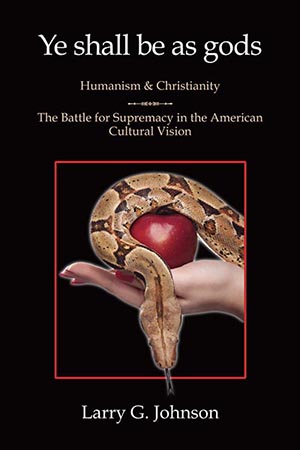
Larry G. Johnson, Ye shall be as gods – Humanism and Christianity – The Battle for Supremacy in the American Cultural Vision, (Owasso, Oklahoma: Anvil House Publishers, 2011), pp. 229, 334-235, 354, 356.

Richard M. Weaver, Visions of Order, (Wilmington, Delaware: Intercollegiate Studies Institute, 1964), pp. 22-23.

Postcard from Hell

“It would rain fetuses. Fetuses and blood all over the place…I felt like a fireman in hell. I couldn’t put out all the fires.” These are the words of Steven Massof, one of the employees in an abortion clinic operated by Dr. Kermit Gosnell, describing the busy times when the women were given drugs to induce contractions all at once. Gosnell is on trial this week for killing seven children and a young mother in a filthy, blood-splattered clinic near Philadelphia.

The babies had the misfortune to be born live in Gosnell’s abortion clinic staffed in part by teenagers posing as licensed anesthetists. The bodies of the tiny victims were stored in a freezer in the basement of the clinic. Massof admitted that killing babies born alive was standard procedure at the clinic. He estimated that at least 100 babies were born alive in the clinic and had their necks snipped, but the beheadings were so routine that no one could determine the exact number.

Generally, such stories of horrific tragedies would be meat for the media grinder. However, you probably have not heard much if any reports from the great majority of news media. But thanks to the Family Research Council and other conservative organizations and leaders, the story which the media have ignored or censored is gaining some attention.

Sherry West was another long-time employee of the clinic. She testified that she called the babies specimens “because it was easier to deal with mentally.” West recalled one incident of a “screaming baby that really freaked me out…I can’t describe it. It sounded like a little alien.” She estimated the baby to have been between 18 and 24 inches long, one of the largest she had seen during abortion procedures at the Women’s Medical Society clinic operated by Dr. Gosnell at that time.

Perhaps you will recall President Clinton’s statement that abortions in America should be “safe, legal, and rare.” But his statement is just political sop to pacify the squeamish. The same sop to hide abortion’s grisly reality was used by Alisa LaPolt Snow, the Florida Alliance of Planned Parenthood Affiliates lobbyist, in her testimony regarding a bill before the Florida legislature that would require abortionists to provide medical care to an infant who survives an abortion. In response to being asked what would Planned Parenthood do if a live baby were born on a table as a result of a botched abortion, Snow replied, “We believe that any decision that’s made should be left up to the woman, her family, and the physician.”

Effectively, Planned Parenthood would leave the life or death decisions to the Dr. Gosnells of the world with regard to babies born alive after a botched abortion. Certainly the mother is in no emotional or physical shape to make a thoughtful and rational decision, and it is extremely unlikely that the doctor would consult the mother’s family (generally not present anyway) as the baby is lying on the table and struggling for life. Apart from lack of sanitation and improper licensing, Planned Parenthood would have little to no issues with Dr. Gosnell’s methods and decision-making process with regard to killing a live baby.

After January 22, 1973, the lives of unborn babies were no longer sacrosanct in America but placed in the hands of the deciders following the dictates of man’s law. It is estimated that over fifty two million abortions have fallen victim to man’s law in America from January 1973 through the end of 2008. These estimates came from direct surveys of abortionists by the Guttmacher Institute, once a research affiliate of Planned Parenthood. The number of abortions per day, if an average were calculated for the entire thirty-six year period, is over 3,900. This average number of abortions per day exceeds by over one thousand the number of lives lost in the terrorist attacks on September 11, 2001.

Numbers and statistics are sterile things and do not convey the horror of a single abortion as shown above. Euphemisms, platitudes, and legal arguments about rights, privacy, and choice attempt to soften the picture or divert our attention from the horror surrounding the abortion of an unborn child.

Legalized abortion was the wedge used to split open the historic Western commitment to the dignity of human life. Now the humanist defenders of abortion continue attempts to drive the wedge deeper by sanctioning the taking of innocent life which effectively dispenses with concerns as to when human life begins. Thus, the abortionists’ coveted right of choice is attempting to move across the line from abortion to infanticide. Doubters only need to listen to the testimony of Planned Parenthood spokeswoman Alisa LaPolt Snow.

Many scientists and academics would not stop at aborting babies born alive as the result of a botched abortion. Some such as Francis Crick, Nobel Prize winner for discovering the double helix in DNA, support screening newborns. For Crick, those that fail to meet certain health standards would be euthanized. Peter Singer, Princeton’s DeCamp Professor of Bioethics, believes that parents ought to be allowed to kill their disabled children. His reasoning is “…that they are ‘nonpersons’ until they are rational and self-conscious.” Singer extends his reasoning to the “…killing of incompetent persons of any age if their families decide their lives are ‘not worth living’.” Some would scoff that Crick’s and Pinker’s opinions are extreme and would never gain cultural acceptance. However, legalized abortion in America was also once thought extreme by most Americans.

Under the aegis of a majority of nine people on the United States Supreme Court, abortion became a choice in 1973, and unborn babies suddenly became mere fetal tissue with potentiality for human life. Contrast the Supreme Court’s decision and humanism’s convoluted defenses of abortion through fictitious rights and irrational moralizing about choice with the words of the Psalmist:

You made all the delicate, inner parts of my body, and knit them together in my mother’s womb. Thank you for making me so wonderfully complex! It is amazing to think about. Your workmanship is marvelous—and how well I know it. You were there while I was being formed in utter seclusion! You saw me before I was born and scheduled each day of my life before I began to breathe. Every day was recorded in your Book! [Psalm 139:13-16. Living Bible]

Larry G. Johnson

Sources:

John Hayward, “Kermit Gosnell’s House of Screams,” Human Events, April 8, 2013. http://www.humanevents.com/2013/04/08/kermit-gosnells-house-of-screams/ (accessed April 10, 2013).

Tony Perkins, “Washington Update,” Family Research Council, April 9, 2013. http://www.frc.org/washingtonupdate/braking-news-media-halts-coverage-of-serial-killer (accessed April 10, 2013).

“At Gosnell trial, Del. woman testifies scene ‘freaked me out,” delawareonline.com, April 9, 2013. http://www.delawareonline.com/article/20130409/NEWS/304070067/ (accessed April 10, 2013).

Larry G. Johnson, Ye shall be as gods – Humanism and Christianity – The Battle for Supremacy in the American Cultural Vision, (Owasso, Oklahoma: Anvil House Publishers, 2011), pp. 344, 350-351.

The New Despotism – Part II

In Part I we learned that humanistic definitions of equality have played a central role in the ascendance of a new despotism in America. About 175 years ago, Tocqueville gave a vivid picture of this new type of oppression that would threaten democracies and which “…will not be like anything there has been in the world before…” He admitted that he was having trouble naming this new despotism but “wished to imagine under what new features despotism might appear in the world”:

I see an innumerable crowd of men, all alike and equal, turned in upon themselves in a restless search for those petty, vulgar pleasures with which they fill their souls…Above these men stands an immense and protective power which alone is responsible for looking after their enjoyments and watching over their destiny. It is absolute, meticulous, ordered, provident, and kindly disposed. It would be like a fatherly authority, if, father-like, its aim were to prepare men for manhood, but it seeks only to keep them in perpetual childhood; it prefers its citizens to enjoy themselves provided they have only enjoyment in mind. It works readily for their happiness but it wishes to be the only provider and judge of it. It provides their security, anticipates and guarantees their needs, supplies their pleasures, directs their principal concerns, manages their industry, regulates their estates, divides their inheritances. Why can it not remove from them entirely the bother of thinking and the troubles of life?

Thus, it reduces daily the value and frequency of the exercise of free choice; it restricts the activity of free will within a narrower range and gradually removes autonomy itself from each citizen. Equality has prepared men for all this, inclining them to tolerate all these things and often see them as a blessing.

Thus, the ruling power, having taken each citizen one by one into its powerful grasp and having molded him to its own liking, spreads it arms over the whole of society, covering the surface of social life with a networked of petty, complicated, detailed, and uniform rules through which even the most original minds and the most energetic of spirits cannot reach the light in order to rise above the crowd. It does not break men’s wills but it does soften, bend, and control them; rarely does it force man to act but it constantly opposes what actions they perform; it does not destroy the start of anything but it stands in its way; it does not tyrannize but it inhibits, represses, drains, snuffs out, dulls so much effort that finally it reduces each nation to nothing more than a flock of timid and hardworking animals with the government as shepherd.

The word Tocqueville was searching for in describing this new despotism was socialism, and his words have painted a prophetic and hauntingly real picture of the United States in the 21st century under the humanists’ leadership in the institutions of American life: government, education, economics, the sciences (physical, biological, and social), popular culture, and the family. Socialism is the end result of a society that pushes towards the humanist worldview of which the humanists’ definition of equality is central.

Why does humanism require a society organized under socialistic principles? First, socialism is a prerequisite for a humanist society. It is a cardinal tenet of the Humanist Manifesto I of 1933 which says: “A socialized and cooperative economic order must be established to the end that the equitable distribution of the means of life be possible.” For the humanist, equitable distribution means re-distribution and redistribution means socialism. Second, if one examines humanism and its goals, those goals can only be achieved through the imposition of a socialistic system of controls because the fundamental nature of man conflicts with the humanistic worldview. Being created in the image of God and given a free will, humans have an innate thirst for freedom which socialism suppresses.

The restrictions of the humanist society are decided by the social engineers of that society, the elites or “conditioners” as C. S. Lewis called them. Thus, humanism is a top down affair. Its leaders determine what is best for the masses based on man’s laws, not God’s laws. Socialism is humanism’s default setting for organizing society and is inherently domineering, restrictive, and restraining in the details of life and ultimately leads to loss of freedom in every aspect of life.

In a society built upon the biblical worldview, men join together and voluntarily limit their freedom. But the imposition of limits comes from a group of like-minded individuals whose central cultural vision reflects the same biblical worldview of freedom and the nature of man.

In concluding his description of the new despotism, Tocqueville stated that, “The vices of those who govern and the ineptitude of those governed would soon bring it (the nation) to ruin and the people, tired of its representatives and of itself, would create freer institutions or would soon revert to its abasement to one single master.” Given the apparent abdication by Congress of its designated role in the separation of powers and the proclivity of the Executive Branch in disabusing the judiciary, ignoring enforcement of the laws passed by Congress, and governing through illegitimate executive orders and presidential whim, it appears that America, through the ineptitude of the electorate, has chosen its abasement through one single master.

It’s time for pushback.

Larry G. Johnson

Sources:

Paul Kurtz, ed., Humanist Manifestos I and II, (Amherst, New York: Prometheus Books, 1973), p. 10.

Alexis De Tocqueville, Democracy in America, Gerald E. Bevan, Trans., (London, England: Penguin Books, 2003), pp. 805-806, 808.

The New Despotism – Part I

Equality is a good thing. Right? Your first reaction may be, “Of course it is. It‘s even in the Declaration of Independence… ‘All men are created equal’.” But let’s give a little more thought and consideration to this topic. Do you really want your doctor to be equal to all other doctors? Do you want the airline pilot on whose plane you are a passenger to be equal with all other airline pilots? Of course not! You want your doctor to be the best doctor available when dealing with your health and that of your family. The same goes for the airline pilot on whose plane you are a passenger. So, we can’t just worship at the shrine of equality and say that equality in everything is good as so much of society seems to be doing these days.

In the culture wars, both sides support equality but have fundamentally different notions about what equality means and how it should be implemented and administered in all institutions of American life. One understanding of the meaning of equality has contributed to the United States becoming the most exceptional nation in the history of the world. The other meaning is contributing significantly to the disintegration of American culture as envisioned by the Founders.

Now, I don’t want your eyes to glaze over as you think about the concept of equality. This is not an academic exercise because a correct understanding of equality will help you determine on which side of the culture war you stand and allow you to recognize and defend the meaning of equality as understood by the Founders in establishing this nation and designing our Constitution.

We begin with an abbreviated summation of the meaning of equality. Here we speak of equality in light of the individual within the Founders’ meaning on the one hand versus the meaning as defined by the humanist levelers of the 21st century.

The founding Americans held a biblical worldview and relied on order that rested upon a respect for prescriptive rights and customs as opposed to the egalitarian notions of the French philosophers during the French Revolution. This difference was made clear by John Adams’ definition of equality which strikes at the heart of what it really means—a moral and political equality only—by which is meant equality before God and before the law. This definition does not teach that all men are born to equal powers, mental abilities, influence in society, property, and other advantages. Rather, all men are born to equal rights before God and the law and by implication to enjoy equal opportunity.

The humanistic definition of equality is clearly stated in Humanist Manifesto II’s eleventh common principle, “The principle of moral equality must be furthered…This means equality of opportunity…” But, the humanists’ meaning of “equal opportunity” is immediately and drastically corrupted to mean an equality of outcome as measured by humanist requirements. To further clarify the intent of the signors of the Manifesto, the document states that, “If unable [by means of equal opportunity], society should provide means to satisfy their basic economic, health, and cultural needs, including whatever resources make possible, a minimum guaranteed annual income.” This concept of human equality flows from the flawed humanistic assumption of the perfectibility of man. Under this concept, what men are comes from experience. Therefore, men are equal at birth, and differences and inequalities arise due to environment.

The goal of humanists was to achieve an egalitarian society (and eliminate inequalities due to environment) through political means in which man, achieving perfect equality in their political rights, would at the same time be perfectly equalized and assimilated in their possessions, their opinions, and their passions. When humanists failed to achieve equality of outcome through political equality, the levelers demanded economic democracy, a new and expanded humanist definition of equality. However, economic democracy still means an equality of condition as opposed to equality of opportunity and is to be achieved through recognition of invented or synthetic rights coupled with broad but non-specific egalitarian ideals. As society is leveled with guarantees of certain outcomes to its citizens, political equality suffers, that is, imposed equality of outcome will destroy equality before the law.

We see evidence of the humanistic definition of equality being imposed on every institution of American life and the ensuing erosion of equality before the law. On an almost 24/7 basis we see and hear media reports from the battle fronts of the culture wars with regard to issues of perceived inequality including gay marriage, universal health care, women in combat roles, immigration, race, and employment. Some are issues dealing with equality before the law (excluding laws based on synthetic or invented rights), and the nation has and is promoting equality in those areas (e.g., race and employment discrimination). But even in those legitimate areas of concern, humanist organizations, politicians, and bureaucrats push the envelope beyond equality of opportunity.

Democracies are under grave and severe attack by a new despotism. Humanistic definitions of equality have played a central role in the ascendance of this despotism. In Part II we shall name this despotism and diagnose its operation and impact on the nation.

Larry G. Johnson

Sources:

Larry G. Johnson, Ye shall be as gods – Humanism and Christianity – The Battle for Supremacy in the American Cultural Vision, (Owasso, Oklahoma: Anvil House Publishers, 2011), pp. 394-395.

Paul Kurtz, ed., Humanist Manifestos I and II, (Amherst, New York: Prometheus Books, 1973), p. 20.

Thank you, Grace. You are worthy of your name.

Grace Evans is an 11-year old Minnesota girl who testified earlier this month before a Minnesota statehouse committee as it deliberated on a bill to permit gay marriage. (The committee subsequently approved the bill which was sent to the full house. A similar bill is in the state senate.)

Speaking against passage of the bill to allow gay marriage in Minnesota, Grace talked of the importance of each of her parents and that each parent provides something unique to her life that can’t be provided by the other. “Even though I’m only 11 years old, I know that everyone deserves to have a mom and a dad. If you change the law to say two moms and two dads can get married, it would take away something very important for children like me across the state.”

Grace’s approximate two-minute address included twenty-one seconds of silence as she twice asked the committee members, “I know some disagree, but I want to ask you this question: Which parent do I not need – my mom or my dad?” She waited, but no committee member answered her question.

Even though Grace is only eleven, she recognizes that marriage between a man and a woman is a cultural universal. It transcends time and space because it is a reflection of the nature of God. To give a better understanding of what I mean and what Grace understands, I quote from my book:

As one reflects on how humans have organized themselves over time, there is and has been a great diversity of societal forms in different cultures and periods of history. However, underlying this variety is a structured order or arrangement that reflects the “creational givens.” One of these givens is that the family structure is a societal institution established by the Creator. And the family structure consisting of “…a father, mother and children living together in bonds of committed caring is not an arbitrary happenstance; nor is it mere convention that can be dismissed when it has outlived its usefulness.” This ordered family structure is a part of the human constitution and is ingrained in man’s nature in all of its facets—biological, emotional, social and moral. This structure allows for variety but sets definite boundaries, i.e., lines that cannot be crossed without being in opposition to the structured order of the family. [Larry G. Johnson, Ye shall be as gods – Humanism and Christianity – The Battle for Supremacy in the American Cultural Vision, (Owasso, Oklahoma: Anvil House Publishers, 2011), pp.307-308; quoted portions are from: Albert M. Wolters, Creation Regained, 2nd Ed., (Grand Rapids, Michigan: William B. Eerdmans Publishing Company, 2005), p. 95.]

In Christianity, the marriage relationship was of such importance that it is described in terms of Christ’s relationship with the church (his bride) and is a reflection of the character or nature of God. And that marriage relationship is unmistakably to be between a man and a woman for the Bible gives a very clear understanding of God’s view of homosexuality in the book of Romans.

Therefore God gave them up in the lusts of their hearts to impurity, to the dishonoring of their bodies among themselves, because they exchanged the truth about God for a lie and worshiped and served the creature rather than the Creator, who is blessed forever! For this reason God gave them up to dishonorable passions. Their women exchanged natural relations for unnatural, and the men likewise gave up natural relations with women and were consumed with passion for one another, men committing shameless acts with men and receiving in their own persons the due penalty of their error. [Romans 1:24-27 RSV.]

Even though the legitimization of same-sex marriage is relatively new, its devastating effects are already being felt in those countries that have allowed it. Documenting 10 years of same-sex marriage and civil unions in Denmark, Norway, and Sweden, Hoover Institution researcher Stanley Kurtz has found that it has led to far fewer marriages and soaring illegitimacy in which “80 percent of firstborn children are born out of wedlock, and 60 percent of children born thereafter are born to unwed parents. This has a devastating impact on children since unmarried parents are much more likely to separate.” Kurtz wrote, “Marriage in Scandinavia is in deep decline, with children shouldering the burden of rising rates of family dissolution. And the mainspring of the decline—an increasingly sharp separation between marriage and parenthood—can be linked to gay marriage.”

Of course Grace and her parents have received much attention since her testimony. She has been called many things including a “stupid indoctrinated child” and an “11-year old bigot” (a favorite word for those who defend gay marriage). Her parents have been described as spoon feeding the script to Grace and that they need to check into a mental hospital. Given the amount of vitriol spewed against the opponents of the bill, my guess is that we can’t depend on the assurances of supporters of gay marriage that its passage won’t affect religious freedom or freedom of speech.

Should the bill become the law of Minnesota, one can easily envision parents such as the Evanses being charged with child abuse or having their children removed from their home for teaching the biblical view of homosexuality and marriage. If one is doubtful of the intentions and reach of bureaucrats and judges with a humanistic worldview, review the case of a 10-year old New Hampshire girl. A New Hampshire court ordered the home-schooled girl into a government-run school because “her religious beliefs (Christian) are a bit too sincerely held and must be sifted, tested by, and mixed among other worldviews…” The court agreed that the 10-year-old Christian girl is “social and interactive with her peers” and “intellectually at or superior to grade level…” However, the court found that the girl “appeared to reflect her mother’s rigidity on questions of faith” and that her interests “would be best served by exposure to a public school setting” with “different points of view.” [“Home-Schooler Ordered to Attend Public Classes,” Pentecostal Evangel, November 15, 2009, 23.]

One of the definitions of “grace” found in Noah Webster’s 1828 dictionary reads as follows: “That [quality] in manner, deportment or language which renders it appropriate and agreeable; suitableness; elegance with appropriate dignity. We say, a speaker delivers his address with grace…” Grace, your name fits you well. You are a true Culture Warrior. Thank you for your courage.

Larry G. Johnson