Rss

  • youtube

The most powerful weapon

The terrorist will argue that the bomb is the most powerful weapon. Who can dispute the destructive power of a nuclear bomb? Others will declare the airplane or drone is the most powerful weapon because those deliver the bombs and without the means of delivery their explosive power would be dormant or ineffective.

Yet, others will say that the question of power overlooks the greater question of purpose. The target for which a weapon is used is the more important consideration than the power of the weapon itself. The assassin may prefer the thrust of a well-aimed stiletto, for the garrotter the seemingly innocuous cord is the weapon of choice, and for the timid or less-strong a few grams of cyanide in the victim’s cocoa will suffice. And we must not forget the megalomaniac or neighborhood bully’s invisible weapons of fear and intimidation.

A third group will submit that it is not a question of the powerfulness of a weapon or choosing the correct weapon to fit the target. Rather, the important thing is that a weapon is not inherently evil in itself but can be used for both good or ill. The laser used to destroy enemies can destroy the cataract to improve sight. The poison of chemo-therapy kills the cancerous portions of the body in order to sustain the larger organism. The bullet that kills the dictator bent on genocide may save thousands of lives.

Weapons evolve over time. The first weapons were blunt instruments (fists, stones, or clubs) and still favored in some detective stories. The up-close-and-personal blunt instrument was replaced by the more impersonal projectile (the arrow, the bullet, and the bomb). Through man’s ingenuity and industriousness, each generation of weapons provides new ways to oppress, maim, and kill. In time all weapons deteriorate and become ineffective. Even the bully’s power fades, and he is replaced by a younger, stronger thug. Although weapons corrode or become obsolete and tyrants die, there is one thing that never loses its power and never grows old. It is the word.

The supreme importance of two things is shown by their existence in God’s realm before He created the universe and all therein including man: the word and love. How is this possible? It is possible because God was the word and God is love. We know this from John’s gospel. “In the beginning was the Word, and the Word was with God, and the Word was God. He (Jesus) was in the beginning with God…” [John 1:1. RSV] We are told in 1 John 4:8 that, “…God is love.” In the Revelation to John we also see that God’s love for His special creation existed before creation itself, “And all mankind—whose names were not written down before the founding of the world in the slain Lamb’s book of life—worshipped the evil creature.” [Revelation 13:8, Living Bible] [emphasis added] God loved man before his creation. God did not need man’s love, but rather it was a will to love, an expression of the very character of God, to share the inner life of the Trinity.

Language is unique to mankind. To compare the screeches, grunting, and howls of various species to that of human language is to compare mere recognition of night from day to that of a watch of intricate precision which can measure time to an accuracy of a fraction of a second. Richard Weaver wrote of the power of the word.

[There is an]…ancient belief that a divine element is present in language. The feeling that to have power of language is to have control over things is deeply imbedded in the human mind. We see it in the way men gifted in speech are feared or admired; we see it in the potency ascribed to incantations, interdictions, and curses. We see it in the legal force given to oath or word.[1]

The author of the New Testament book of James called the tongue a small member of the body but which boasts great power. He compares it to a small fire that can set ablaze a great forest. James also speaks of the difficulty of taming the tongue and the great harm it can cause. “For every kind of beast and bird, of reptile and sea creature, can be tamed and has been tamed by humankind, but no human being can tame the tongue—a restless evil, full of deadly poison.” [James 3:5, 7-8. RSV]

In the first chapter of Genesis we see that God spoke into existence the universe, the earth, and all therein, and a divine order was stamped on creation. Man was God’s special creation and given dominion over the earth and the power of the word to name every creature. But man rebelled against God’s order and was separated from a right relation with Him. Disorder now ruled man’s life.

As Weaver has said, speech is a divine element for humans were made in the image of God. But man is a fallen creature, and the poet Ralph Waldo Emerson sums up the consequences, “The corruption of man is followed by the corruption of language.”[2] In His revelation, God instructed man on how he ought to live life and included the right use of the word. Such was the importance of the word to God, His instruction to man as to the proper use of the word required two of the Ten Commandments, “You shall not take the name of the Lord your God in vain; for the Lord will not hold him guiltless who takes his name in vain…You shall not bear false witness against your neighbor.” [Exodus 20: 7, 16. RSV]

For all of man’s time on earth language has been the means of achieving order in culture. But in this modern age humanists have effectively used semantics to neuter words of their meaning in historical and symbolic contexts, that is, words now mean what men want them to mean.[3]

We live in a world of increasing disorder sustained and propelled by the perversion of language in which the meaning of words and ideas are separated from truth. Weaver recognized the folly of such perversion, “…here begins that relativism which by now is visibly affecting those institutions which depend for their very existence upon our ability to use language as a permanent binder.”[4] Words freed from the anchor of truth (reality) disorient and provide no clarity or direction regarding fixed, eternal values necessary for order that mankind craves and requires for living life.

The ordering and sustaining power of truthful words reverberates through history. Whether our words are a weapon of evil or an instrument of good is a matter of choice, and three thousand years ago Solomon identified the importance of that choice when he said there is power of life and death in the tongue. We must choose life, and life is found in biblical truths revealed to the ancient Hebrews and first century Christians.

Larry G. Johnson

Sources:

[1] Richard M. Weaver, Ideas Have Consequences, (Chicago, Illinois: The University of Chicago Press, 1948), p. 148.
[2] Ibid.
[3] Ibid., pp. 148, 151.
[4] George M. Curtis, III and James J. Thompson, Jr., eds., The Southern Essays of Richard M. Weaver, (Indianapolis, Indiana: Liberty Fund, 1997), p. 196-197.

The end of sustainable government

America has been a wildly successful country because of its sustainable government, and we can thank our founders for making that possible. However, the Obama presidency has done more to damage that sustainability than any administration in the nation’s history.

All governments are systems of ruling or controlling, and every system of government has a source of power. Every government’s source of power may be visualized as being at some point on a continuum of power. At one end of the continuum is anarchy at which there is no law, no order, and no systematic control and quickly slides into some form of tyranny. Tyranny resides at the other end of the continuum and imposes too much control and results in loss of freedom, oppression, and eventual slavery. Under the one system there is no law; under the other is the ruler’s law. What the Founders’ desired was a people’s law with “…enough government to maintain security, justice, and good order, but not enough government to abuse the people.”[1]

People’s law resides at the center of the continuum between anarchy and ruler’s law. How is this achieved? The Founders began their task with an understanding of the tendency of governments and cultures throughout history to swing from one extreme (tyranny) to the other (anarchy) and back. The Founders also recognized the difficulties of sustaining a government based on the people’s law because of the inherently corrupt nature of mankind.

In creating a government that was sustainable, the Founders recognized the inherent fallibility of any system of government based solely on law designed and guided by corrupt human nature that ultimately devolves into a succession of governments of tyrants or roiling mobs. To address the tendency of governments to fluctuate between the extremes of tyranny and anarchy, the Founders formed a government based on constitutionalism. A constitution designed by the people to reflect the people’s law marks the boundaries or limits of power delegated to the rulers of government. Because the Founders recognized the truth of the fallen nature of man, the American Constitution included a system of checks and balances known as the separation of powers.

By the late nineteenth century the tentacles of humanism would spread into American jurisprudence and began to undermine the biblical foundations of the law that had been laid by the Founders and threatened the restraining force of the Constitution. The new theory of law was based on relativism and introduced by Harvard Law School Dean Christopher Langdell in the 1870s. The major tenets of the progressivists’ theory of law are:

There are no objective, God-given standards of law, or if there are, they are irrelevant to the modern legal system.

Since God is not the author of law, the author of law must be man; in other words, the law is law simply because the highest human authority, the state, has said it is law and is able to back it up.

Since man and society evolve, therefore law must evolve as well.

Judges, through their decisions, guide the evolution of law.

To study law, get the original sources of law – the decision of judges.[2]

In his incisive indictment of progressivism in American jurisprudence, Bradley C. S. Watson states that “…such jurisprudence is destined to be destructive to any and all claims of moral truth…not only hostile to the liberal constitutionalism of the American Founders, but to any moral-political philosophy that allows for the possibility of a truth that is not time-bound.”[3]

Watson believes that there are two fundamental facts that mark the founding of America and subsequently the design of the Constitution. One was creedal and one was cultural. First, the Founders had a creedal “…understanding of natural rights, which were held not to be culturally derived or time-bound or subject to infinite incremental growth, but applicable to all men everywhere and final.” [emphasis added] In other words, there were eternal truths which transcended man and his time on this earth and were inviolable. Second, the Founders believed that American culture resulted from inherited or customary understandings that reflected the application or working out of the principles of timeless truths in daily life. The Founders’ creedal and the cultural beliefs were not in conflict but expressions of the same truth, and both rested firmly on the foundation of the Judeo-Christian faith and its eternal truths.[4] These two facts regarding the founding of America stand in stark contrast to progressivism’s faulty assumptions of the evolutionary nature of the Constitution and laws.

Because of the nature of the duties of the judiciary, Progressivists’ damage to the separation of powers under the Constitution has occurred primarily within that branch of government. But the brazen overreach of the Obama administration through disregard of Constitutional limits on executive powers may be unparalleled in American history. In addition to scorning the rebukes by the Supreme Court for his un-Constitutional executive actions, the President has violated his Constitutional duty to faithfully execute the laws by selective enforcement and/or changes to laws enacted by Congress. Additionally, the administration has regularly circumvented the powers of the legislative branch through the issuance of illegitimate executive orders to accomplish what Congress would not approve.

Such is the seriousness and extent of the abuse of power of the executive branch that on July, 16, 2014, Constitutional scholar Jonathan Turley, Shapiro Professor of Public Interest Law at George Washington University, appeared before the Committee on Rules of the U.S. House of Representatives to discuss litigation for actions by the President inconsistent with his duties under the Constitution. In his prepared remarks, Turley stated:

The President’s pledge to effectively govern alone is alarming but what is most alarming is his ability to fulfill that pledge. When a president can govern alone, he can become a government unto himself, which is precisely the danger that the Framers sought to avoid in the establishment of our tripartite system of government. In perhaps the saddest reflection of our divisive times, many of our citizens and Members are now embracing the very model of a dominant executive that the Framers fought to excise from our country almost 250 years ago.[5]

Sustainable government requires adherence to Constitutional limitations of power and the recognition of and adherence to timeless fixed moral and political truths from which there can be no departure. However, because of the ascendance of the humanistic worldview, there is an assault on these principles necessary to sustain government. In American jurisprudence this assault is a result of judicial activism that changes or creates laws or goes against precedent rather than just applying or interpreting laws. The more recent assault on the Constitution by the executive branch is evident in the maneuverings of a president seemingly bent on one-man rule based on man’s law disconnected from eternal truths.

As a result of these onslaughts, the hard-won people’s law of the Founders is endangered, and the end of our once sustainable American government is at hand. It is time for the states, Congress, and the American people to reign in the judicial and executive branches of government and return to the Constitutional balanced of powers as Madison and the delegates to the Constitutional Convention intended.

Larry G. Johnson

Sources:

[1] W. Cleon Skousen, The 5000 Year Leap, (www.nccs.net: National Center for Constitutional Studies, 1981), pp. 10, 19.
[2] David Barton, Original Intent, 5th Edition, (Aledo, Texas: Wallbuider Press, 2008), pp. 233-234.
[3] Bradley C. S. Watson, Living Constitution, Dying Faith, (Wilmington, Delaware: ISI Books, 2009), p. xvi.
[4] Ibid., pp. 23-14.
[5] Jonathan Turley, “Authorization to Initiate Action for Litigation for Actions by the President Inconsistent with His Duties under the Constitution of the United States,” Committee on Rules, U.S. House of Representatives, July 16, 2014. http://docs.house.gov/meetings/RU/RU00/20140716/102507/HMTG-113-RU00-Wstate-TurleyJ-20140716.pdf (accessed August 11, 2014).

Acts of God or Acts of Man?

The phrase “an act of God” is typically associated with destruction, loss, pain, and suffering beyond the control of man. Many property and casualty insurance policies contain exclusions of coverage on losses attributed to “acts of God” because certain massive acts of nature can’t be controlled such as earthquakes, floods, and hurricanes. However, other less pervasive natural and therefore insurable occurrences such as tornadoes, hail, storms, high winds, and ice may be covered. War, although man-made, is often included in these exclusions. Then there are other uninsurable catastrophes such as famine, pandemic disease, and pestilence that kill millions each year. For many, the biblical God of love has a lot to answer for if these actions are truly His responsibility.

It seems that God gets blamed for most if not all of the evil in the world. If He is not blamed for causing it, then He is blamed for not preventing it. For several well-known individuals, a good God cannot exist if He allows such pain and suffering. The last vestiges of Charles Darwin’s Christian faith evaporated upon his daughter’s painful death. Likewise, billionaire Ted Turner became an outspoken unbeliever upon his sister’s death from a painful disease. “I was taught that God was love and God was powerful, and I couldn’t understand how someone so innocent should be made or allowed to suffer so.” Former well-known evangelist Charles Templeton wrote Farewell to God in 1996. The reason for his rejection of belief in God is revealed by his question, “How could a loving and omnipotent God create such horrors as we have been contemplating?”[1]

So how could a good God allow a world full of pain and suffering to exist? It is a legitimate question, especially for those who deny the existence of God or who reject the biblical answer for mankind’s pain and suffering.

Before we require God to explain the reasons for the existence of pain and suffering in the world, we ought to be in agreement as to the definition and meaning of two words necessary to understand God’s answer: love and freedom. When we speak of love, we refer here to interpersonal relationships (as opposed to the impersonal “I love pizza!”). Our friend Webster describes love as “affection,” “devotion,” “warm attachment,” and “adoration.”[2] But love can one directional and rejected by the intended recipient. Love cannot be commanded, only accepted and returned or rejected. Here we see that love is a matter of choice. One is free to accept or reject love. The popular mantra that “love is all that is necessary” is wrong. We may love the terrorist, but that won’t stop him from maiming and killing innocent people. Even if the terrorist is won over by our love and renounces his terrorist activities, the pain and suffering caused by mindless natural forces can’t be stopped. So, we must agree that love requires freedom for both the giver and recipient.

With this understanding of love and freedom, we are able to comprehend God’s answer for the existence of pain and suffering in the world. To do so we must step back and take in the entire breadth and height of the biblical meta-story of creation including man who was God’s special creation.

God existed before the universe was created, and then God created the universe and all that is within it including the laws that govern that creation. Unlike all of the other elements of his creation, man was created with a free will. This part of the Christian worldview is called Creation. Mankind’s free will allowed man to think and act in ways that were contrary to God’s plan and will for His creation. When man acted in ways contrary to God’s laws (truths), such disobedience to God’s laws was called sin, and as a result decay and death entered into God’s creation. This is called the Fall, and it affected not only man but all of God’s creation. But as God is a loving God, he created a way through His son, Jesus Christ, which allows man to bring order to the chaos he created. This is called the Restoration. There you have the basic elements of the Christian worldview: the Creation, the Fall, and the Restoration. No other worldview recognizes the true nature of the human condition and provides a means whereby man can return to a proper orientation to God’s laws and plan. It answers the questions of where we came from and who we are, what went wrong, and how we get out of the chaos and restore order to our souls.[3]

God’s creation of man with a free will meant the possibility of rejection of God and His love. In other words free will and the potential for rejection of God was the penalty for the possibility of love. So it is on the earthly plane, to risk love is to risk rejection.[4] Pain and suffering entered the world through man’s rejection of God. But man was not the only victim of his rebellion.

Even natural evil—involving earthquakes, tornadoes, floods, and the like—is rooted in our wrong use of free choice. We must not forget that we are living in a fallen world, and because of this, we are subject to disasters in the world of nature that would not have occurred had man not rebelled against God in the beginning. (see Romans 8:20-22)[5]

Humanism is the great competing meta-story and stands in stark contrast on every major point to that of Christianity with regard to man’s creation, purpose, and destiny. The humanistic philosophy denies the existence of all forms of the supernatural, proposes that nature is the totality of being and exists independently of any mind or consciousness. Man is the evolutionary product of Nature, and man has no conscious survival after death due to the unity of body and personality. Humans are masters of their own destiny, and human values are grounded in this-earthly experiences and relationships.[6]

Humanism presents the problem of suffering as the greatest objection to the existence of God. But humanism stands convicted by its own arguments in its denial of the existence of a supernatural God. If there is no supernatural God, and if humans are masters of their own destinies, what is the source of evil that has led to universal pain and suffering in the world? Its worldview has no logical, realistic, or compelling answers. Christian apologist William Craig Lane expresses the humanist’s dilemma.

Paradoxically, then, even though the problem of suffering is the greatest objection to the existence of God, at the end of the day God is the only solution to the problem of suffering. If God does not exist, then we are locked without hope in a world filled with pointless and unredeemed suffering. God is the final answer to the problem of suffering, for He redeems us from evil and takes us into the everlasting joy of an incommensurable good: fellowship with Himself.[7]

As the world is increasingly awash in unfathomable sorrow, pain, and suffering, those who are redeemed by God through the sacrifice of His Son Jesus Christ can take comfort in the words of Christ to His disciples just before His betrayal and death on the cross. “These things I have said to you, that in me you may have peace. In the world you have tribulation; but be of good cheer, I have overcome the world.” [John 16:33. RSV]

Larry G. Johnson

Sources:

[1] Ken Ham and Dr. Jonathan Sarfati, “Why is there death and suffering?” Creation Ministries International,
http://creation.com/why-is-there-death-and-suffering#_ret4 (accessed August 8, 2014).
[2] “love,” Webster’s Seventh New Collegiate Dictionary, (Springfield, Massachusetts: G. & C. Merriam Company,
Publishers, 1963), p. 501.
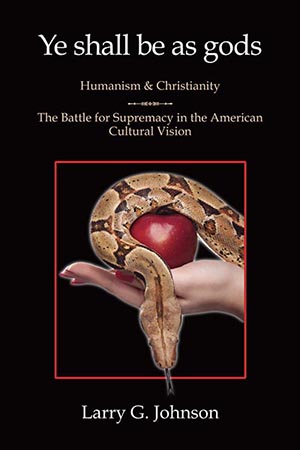
[3] Larry G. Johnson, Ye shall be as Gods – Humanism and Christianity – The Battle for Supremacy in the American
Cultural Vision
, (Owasso, Oklahoma: Anvil House Publishers, 2011), p. 86
[4] Ibid., p. 158.
[5] Ronald Rhodes, “Tough Questions About Evil,” Who Made God? Eds. Ravi Zacharias and Norman Geisler,
(Grand Rapids, Michigan: Zondervan, 2003), p. 37.
[6] Corliss Lamont, The Philosophy of Humanism, Eighth Edition, Revised, (Amherst, New York: Humanist Press,
1997), pp. 13-14.
[7] William Lane Craig, On Guard, (Colorado Springs, Colorado: David C. Cook, 2010), p. 173.

Shake and Bake History – Engineering the future while forgetting the past

Two recent syndicated newspaper columns contained two views of history that frame the two worldviews contending for dominance in the nation’s central cultural vision—humanism and Christianity. The first was written by David Turnoy, a retired elementary teacher and author.[1] Mr. Turnoy is a proponent of ‘honest” history of the warts and all variety with a strong emphasis on the warts. Turnoy’s article is peppered with numerous phrases descriptive of the humanistic worldview, and some of his quotes will help understand that worldview.

For any progressive student or observer of history, it is well-known that the United States has a mixed record in its treatment of Native Americans, African Americans, women and other groups, including some especially cruel treatment…So what information should be taught? Should it be the traditional bland summary showing America as always in the right, led by truly admirable heroes who bring about change while leaving out any negative actions, which leads to disinterested, unquestioning citizens who allow government and other elites to do as they like? Or should it be a more balanced, honest approach?…If we want a better country with more equality and justice, this is where it starts.[2] (emphasis added)

To summarize, it appears that Turnoy believes that traditional history lessons will be bland summaries if not focused on the negatives and therefore produce disinterested and unquestioning citizens who are unconcerned about equality and justice. Turnoy assumes his approach is more balanced and honest. We will examine how Turnoy’s “honest and balanced” approach really plays out in the American education system dominated by a humanistic worldview.

A contrary view is held by Daniel Burnett who believes that there has been a “…growing trend in historical illiteracy for years, and the culprit is our nation’s education system…it fails to prepare students with the knowledge they’ll need for informed citizenship.” Quoting various research studies on knowledge of history in America, Burnett reported that only five percent of the top fifty public universities in the U.S. required even one survey course on American history. Most college and university curricula require only niche courses to take the place of American history courses. He cites several examples: “Foundations of Rock,” “Human Sexuality,” “History of Avant-Garde Film,” and “America Through Baseball.” Burnett believes that the American education system has produced a population of illiterates and amnesiacs as it relates to the nation’s history.[3]

One must ask why there is such an aversion to teaching American history in primary and secondary schools and at colleges and universities. Turnoy argues that history teachers are not honest with regard to America’s failures. Burnett cites the educational system’s focus on niche courses and a failure to teach a comprehensive history of the nation. Both points of view are a result of the educational system’s dominant humanistic worldview and its aversion to the lessons of the past.

American education’s humanistic worldview

The American education system is extremely humanistic in its worldview, teaching, policies, practices, and course content. The great architect of engineering the future through education without a historical foundation was John Dewey. Dewey was “…recognized as the leader of the ‘progressive movement’ in education.”[4] (emphasis added) His educational philosophy, writings, and twenty-five years at Columbia University dramatically shaped the educational system in the U.S. from the early years of the twentieth century until the present day. His philosophy was centered on humanistic concepts of man with regard to his origins, purpose, and future. Dewey had a substantial disdain for historical influence, tradition, patrimony, and religion (particularly the Christian worldview), all of which were noticeably absent in his development of American education’s modern paradigm.[5] The progressive movement in education resulted in faculty hostility to the courses and fields of study that examine the traditional roots of Western civilization and American institutions. Turnoy’s sought after “honest and balanced” presentation of history has been cast aside in favor of indoctrinating American students with a humanistic worldview.

Humanism’s aversion to history

In the humanist worldview history is excess baggage that must be tossed to make way for new, bold, and progressive ideas. Therefore, humanists subscribe to the Whig theory of history which states that the most advanced point in time is the point of its highest development. This fits nicely with humanists’ progressivism whose foundation is the Enlightenment belief of the perfectibility of man, a “…belief that critical and autonomous human reason held the power to discover the truth about life and the world, and to progressively liberate humanity from the ignorance and injustices of the past.”[6] Those holding the humanistic worldview eliminate the traditional historical narrative of America unless that narrative can be sifted and parsed to present selected evidence of America’s supposed widespread historical inequality and injustice.

Rob Koons, a philosophy professor at the University of Texas, has called the modern American university’s array of unconnected courses the Uncurriculum. Koons describes the Uncurriculum as a smorgasbord approach to curriculum offerings whose design usually exhibits a general lack of required courses, structure, and systematic order in meeting core course requirements for liberal arts studies.[7] From such comes a citizenry that is profoundly illiterate with regard to America’s story and the reasons for its preeminence among the past and present nations of the world.

The story of America

America cannot be understood without a comprehensive historical narrative. Such a narrative reveals that America’s founding originated from a biblical worldview that runs through the history of Western civilization since its inception. One cannot understand America by substituting a shake and bake curriculum that substitutes courses such as “America Through Baseball” or “History of Avant-Garde Film” for traditional comprehensive history courses that present the matchless story of America.

Russell Kirk expressed the true ideal of education.

True education is meant to develop the individual human being, the person, rather than to serve the state. In all our talk about “serving national goals” and “citizenship education”—phrases that originated with John Dewey and his disciples—we tend to ignore the fact that schooling was not originated by the modern nation-state. Formal schooling actually commenced as an endeavor to acquaint the rising generation with religious knowledge: with awareness of the transcendent and with moral truths…to teach what it is to be a true human being.[8]

Writing of the humanistic view of education, Richard Weaver’s words capture the goal of such education. “The student is to be prepared not to save his soul, or to inherit the wisdom and usages of past civilizations, or even to get ahead in life, but to become a member of a utopia resting on a false view of both nature and man.”[9]

It is safe to say that the great majority of modern Americans do not understand the true story of America and its institutions. Turnoy and Barnett’s prescriptions to achieve an informed citizenry with regard to American history follow starkly different avenues. Turnoy’s humanistic education model has ruled for the better part of a century and has utterly failed. Barnett offers hope that a return to telling the comprehensive though politically incorrect story of America will result in an informed and politically adept citizenry.

Larry G. Johnson

Sources:

[1] David Turnoy, “When can we introduce children to honest history?” Tulsa World, June 8, 2014, A14.
[2] Ibid.
[3] Daniel Burnett, “Historical amnesia: Let us never forget D-Day,” Tulsa World, June 6, 2014, A14.
[4] Robert B. Talisse, On Dewey, (Belmont, California: Wadsworth/Thompson Learning, 2000), pp. ix, 1, 4.
[5] Larry G. Johnson, Ye shall be as gods – Humanism and Christianity – The Battle for Supremacy in the American Cultural Vision, (Owasso, Oklahoma: Anvil House Publishers, 2011), pp. 23-25.
[6] Christian Smith, The Secular Revolution, (Berkeley, California: University of California Press, 2003), p. 54.
[7] Johnson, p. 300.
[8] Russell Kirk, The Essential Russell Kirk, ed. George A. Panichas, (Wilmington, Delaware: ISI Books, 2007), p. 400.
[9] Richard M. Weaver, Visions of Order, (Chicago, Illinois: The University of Chicago Press, 1948), p. 117.

Did father really know best?

Father Knows Best was a late 1950s television program that depicted an idealized typical middle class family composed of a wise and loving father Jim Anderson, housewife and mother Margaret who was a voice of reason and patience, and three good kids (two teenagers and one pre-teen) whose comedic trials and troubles while growing up provided the basis for most of the weekly plotlines. In the end, Jim with Margaret’s help, would provide the needed sage advice and words of encouragement to whichever of his three children needed it.

Over a half century later, the iconic Anderson family portrayed a different time in America and is considered quaint if not laughable by a modern culture overwhelmed by a humanistic interpretation of the world as it should be. Now, the entertainment media consistently portrays the father figure as an inept buffoon of marginal importance if not irrelevant to the family. In spite of the modern belief in the fiction of the typical 1950s Anderson-type family, it is the humanistic view that is an anomaly, abnormality, or even a perversion that is a stain on the pages of the history of marriage and family.

Stephanie Coontz wrote in her book Marriage, a History, that the male breadwinner/full-time housewife marriages that were the standard in America and Western Europe of the 1950s and 1960s were not a brief historical oddity. Coontz argues that such male-female role characterization was the culmination of a trend that had been growing since the late eighteenth century. For over 150 years there had been continuous movement toward and development of the once radical concept that love should be the basis for marriage and that the marital decision process should be controlled by the couple considering marriage.[1] These dramatic changes began in the eighteenth century and were embraced by both the humanistic and Christian worldviews. However, the meaning and implementation of these changes would become a battleground in the war between the humanistic and Christian worldviews.[2]

The roles of men and women throughout history remainded relatively unchanged. Generally, men in all cultures and times have been the defenders of and providers for the family whereas women have been the nurturers and care givers for husband and children. Whether civilizations are modern or ancient, advanced or primitive, the complementary roles of husbands and wives along the lines just described will be present. Although those roles may or may not have finite and sharp distinctions (depending on the culture and time in history), the basic defender-provider/nurturer-care giver dichotomy remains a constant.[3]

The disappearance of the roles of men and women

The roles of men and women were defined and enhanced by the marriage relationship and made possible the enduring nuclear family unit. During the age of the Enlightenment and in particular the eighteenth century, advances toward the modern nuclear family would also bring dangers that would threaten its survival. These dangers included a more secular view of marriage and sexual relationships propagated by the tide of humanist thought and influence that swept through the nineteenth century.[4] By the 1960s and for the first time in history, the ideal of marriage came under direct attack by social engineers who “…believe a lifelong vow of fidelity is unrealistic or oppressive, especially to women…[and] marriage and family ties were…potential threats to individual fulfillment as a man or woman. The highest forms of human needs, contended proponents of the new psychologies, were autonomy, independence, growth, and creativity,” and marriage was considered a hindrance to fulfilling these human needs.[5]

In 1963 Betty Friedan wrote The Feminine Mystique whose theme centered on the supposed alienation and meaninglessness experienced by the typical housewife.[6] Friedan’s shot across the bow of traditional marriage and family eventually led to the establishment of the National Organization of Women three years later. NOW’s 1966 Statement of Purpose was clear in its efforts to redesign the role of women in American society (and by implication the roles of men and children).

NOW is dedicated to the proposition that women…must have the chance to develop their fullest human potential…it is no longer either necessary or possible for women to devote the greater part of their lives to child-rearing…True equality of opportunity and freedom of choice for women requires such practical, and possible innovations as a nationwide network of child care centers, which will make it unnecessary for women to retire completely from society until their children are grown…We reject the assumptions that a man must carry the sole burden of supporting himself, his wife, and family, and that a woman is automatically entitled to lifelong support by a man upon her marriage, or that marriage, home and family are primarily woman’s world and responsibility—hers, to dominate—his to support…We will seek to open a reexamination of laws and mores governing marriage and divorce…We are similarly opposed to all policies and practices—in church, state, college, factory, or office—which, in the guise of protectiveness, not only deny opportunities but also foster in women self-denigration, dependence, and evasion of responsibility, undermine their confidence in their own abilities and foster contempt for women.[7] (emphasis added)

At its core, the feminist view of the roles of men and women in marriage and family is essentially humanistic which differs markedly from the Christian worldview.

Humanistic worldview

The humanistic worldview and its values focus on the individual person and his/her independence, freedom, self- actualization, autonomy, growth, and creativity. Hence, marriage becomes secondary to the individual and is at best a contractual arrangement devoid of the requirements of covenantal “self-giving” as it interferes with humanistic values…Further, marriage is only one of several relational choices open to the individual. Marriage is not central or necessary for nurturing and the transmission of moral and cultural values to children. The pair-bonding elements of monogamy and permanency are individual decisions and not cultural universals.

Christian worldview

The supreme reflection of God’s image in humankind is in the marriage relationship followed by family. The roles of husband and wife and father and mother (monogamous married couple living with their children) are not societal constructs. The surface patterns and functioning of family may vary markedly in various cultures and societies down through the ages. However, the divinely ordered family structure is intrinsically a part of the fundamental identity of the family in every society and for all time. It is one of those universals or permanent things that are imbedded in the foundation of creation.[8] (emphasis in original)

Essentially, feminists view marriage as a zero-sum game in which gain by one person or side results in a loss by another person or side. In life there are only winners and losers—takers or givers. This is the humanistic worldview in which self is exalted at the expense of relationship. But life is not a zero-sum game. The ordered marital and family structure as reflected in the Christian worldview is a universal which focuses on giving, other-directedness, and relationship.

Not only is life not a humanist zero-sum game, playing the game leads to loss for the whole of society. When humanists and their feminist followers attempt to change the roles of men and women through a change of rules and mores regarding marriage, they discover the inflexibility of the marriage universal. Such changes have led to illegitimacy, cohabitation, divorce, fatherlessness, single-family households, and poverty in which the children face a rootless quest for meaning in life.

Did Jim Anderson always know best? No. But together Jim and Margaret Anderson usually got it right when it came to marriage, family, and life in general. In the Christian worldview, the complementariness of the roles of men and women in the marriage relationship is based on differences. Just as the differences make sexual union possible, the emotional and psychological differences of the marriage partners complement and complete each other, and the union becomes stronger than its parts. It is when the humanists attempt to erase the complementary and unique roles of men and women that marriage, family, and society suffer.

Larry G. Johnson

Sources:

[1] Coontz, Stephanie, Marriage, a History, (New York: Penguin Group, 2005), pp. 4-5.
[2] Larry G. Johnson, Ye shall be as gods-Humanism and Christianity-The Battle for the Central Cultural Vision in America, (Owasso, Oklahoma: Anvil House Publishers, 2011), p. 323.
[3] Ibid., p. 323.
[4] Ibid., p. 325.
[5] Linda J. Waite and Maggie Gallagher, The Case for Marriage, (New York: Doubleday, 2000), p. 1.
[6] “The Founding of NOW,” National Organization of Women website,
http://www.now.org/history/the_founding.html (accessed July 16, 2014).
[7] “The National Organization for Women’s 1966 Statement of Purpose,” National Organization of Women, http://now.org/about/history/statement-of-purpose/ (accessed July 16, 2014).
[8] Johnson, p. 391.